
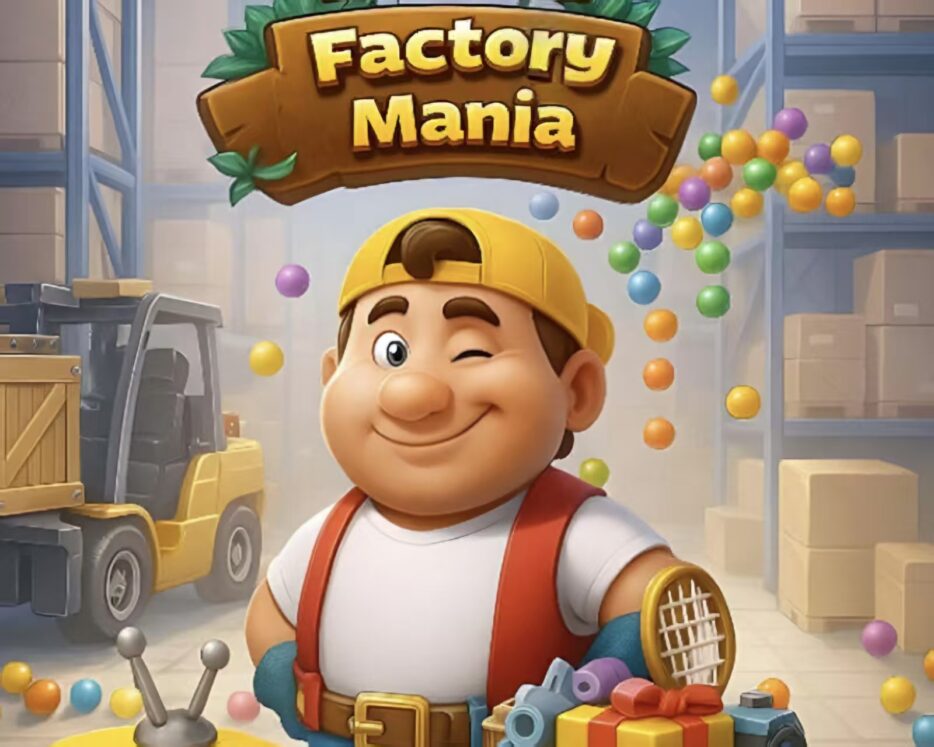
Lately, the mobile gaming market has been flooded with 3D-style tile-matching games, many sharing similar names and core mechanics. Currently topping the US free charts is Match Factory!, which stands out by rendering both the items and their stacking in full 3D. However, at 09GameReview, we’re focusing on another title today – Match 3D Triple: Factory Mania. This game boasts a solid Overall Rating of 4.7 and a key feature for many: it supports offline play.
The player’s task is straightforward: match identical 3D items, arrange blocks, and clear the board of all obstacles. It sounds simple, but organizing and matching piles of stacked 3D objects under a time limit sufficiently challenges your puzzle-solving strategies and skills. The experience of watching “all objects disappear from the screen” is incredibly addictive.
Next, we’ll use the Octalysis Framework to deconstruct the game’s design core and see what keeps us hitting “play again.”
Octalysis Scorecard
The following scorecard is based on 09GameReview’s hands-on experience with Match 3D Triple: Factory Mania, evaluating its performance across the 8 Core Drives.
| Core Drive | Score (1-10) | Evaluation Description |
|---|---|---|
| Epic Meaning & Calling | 7 | NPC storylines (Uncle Ben, Emma, Mr. Reynolds) + the “restoring order” theme provide sufficient driving force. |
| Development & Accomplishment | 8 | Multi-layered feedback system: Level star ratings, chest rewards, building upgrade system. |
| Empowerment & Creativity | 6 | Booster combinations and elimination order planning offer limited strategic space, but don’t reach high-freedom puzzle levels. |
| Ownership & Possession | 8 | Collection and growth system comprising coins, boosters, and upgradable buildings enhances player investment. |
| Social Influence & Relatedness | 5 | Friends system and global leaderboard (e.g., top player at Lv. 5,805) drive competition. |
| Scarcity & Impatience | 8 | Energy system, timed levels, booster consumption, level locks, limited-time “No Ads” offer. |
| Unpredictability & Curiosity | 5 | Randomized level layouts and booster effects provide basic surprises. |
| Loss & Avoidance | 9 | Continue mechanic clearly signals loss; coupled with timer pressure, it leverages the “avoid resetting progress” mindset to drive purchases. |
Evaluation Notes:
Scoring range: 1–10. Higher scores reflect stronger implementation of the core drive and greater player motivation.
GScore (Gamification Score): Calculated using the Octalysis Framework tool.
Octalysis Radar Chart
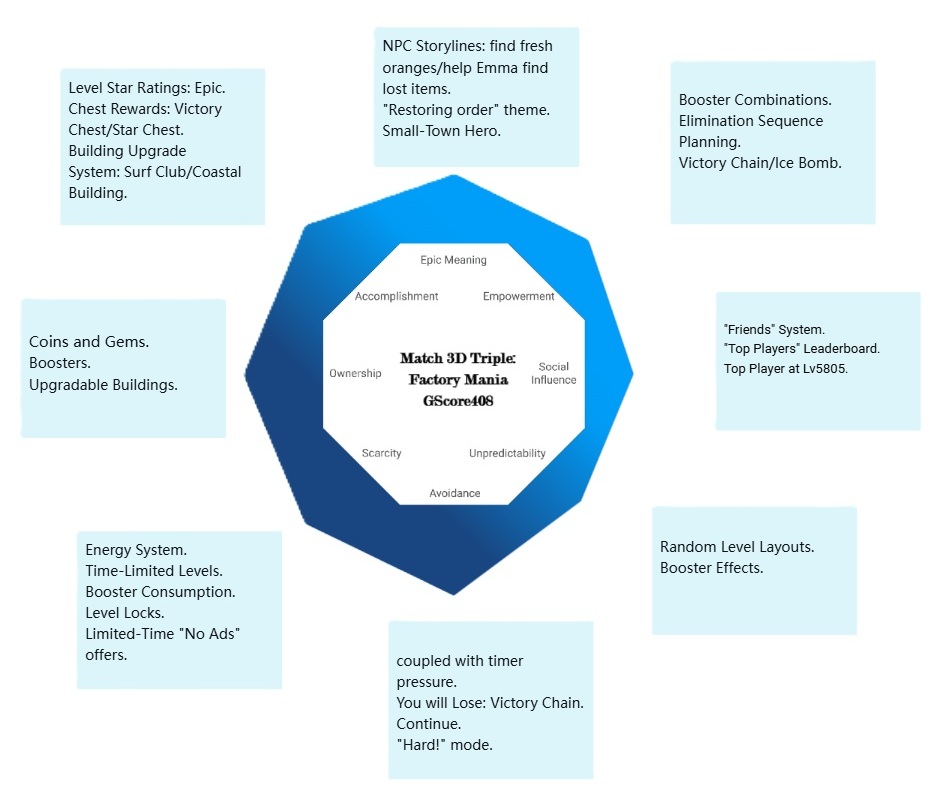
Shape Analysis: The Octalysis chart reveals a distinct “twin-peak profile” (Accomplishment, Avoidance), indicating the game relies heavily on progression feedback and pressure-driven mechanics. Noticeable dips in Social Influence and Unpredictability dimensions highlight its predominantly single-player nature.
Detailed Analysis
1. Epic Meaning (7/10)
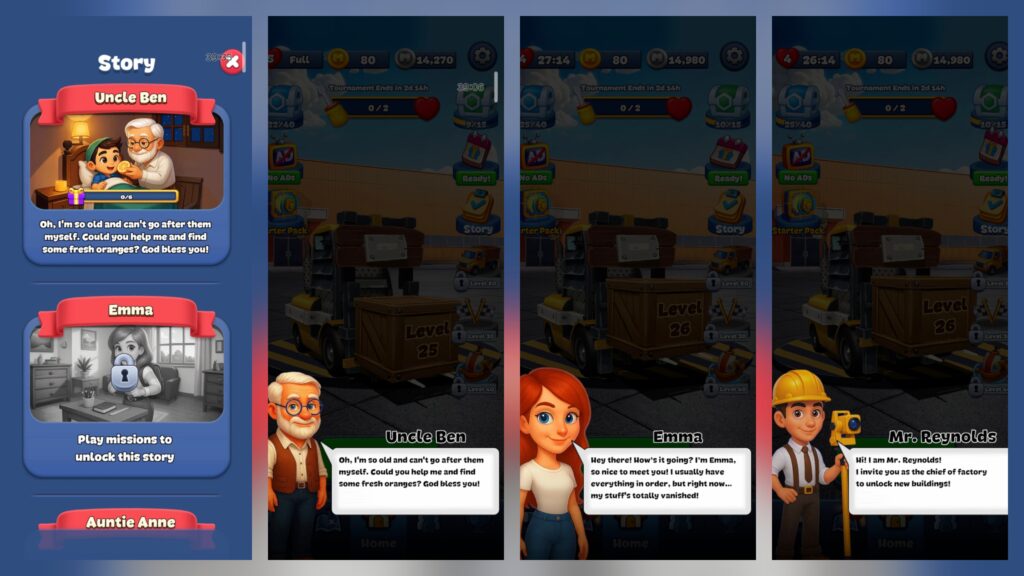
Early on, NPCs like Uncle Ben, Emma, and Mr. Reynolds give you tasks – simple yet heartfelt goals like “find fresh oranges” or “help Emma find her lost stuff,” complete with dialogue like “God bless you!”. This creates a “small-town hero” sense of purpose. While the narrative isn’t complex, progressing the story with each task makes it feel less like mere matching and more like helping characters and building up the town.
2. Accomplishment (8/10)
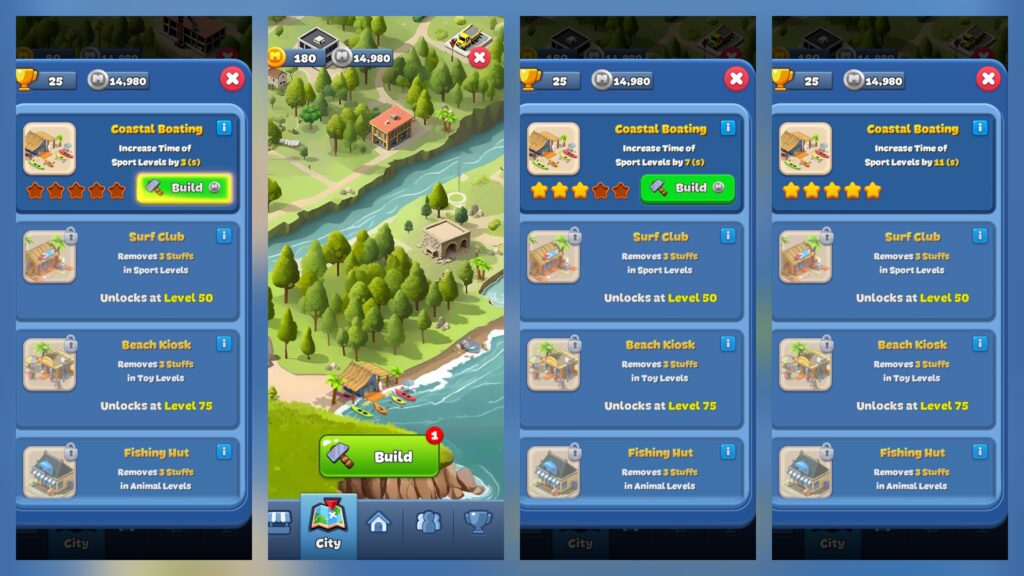
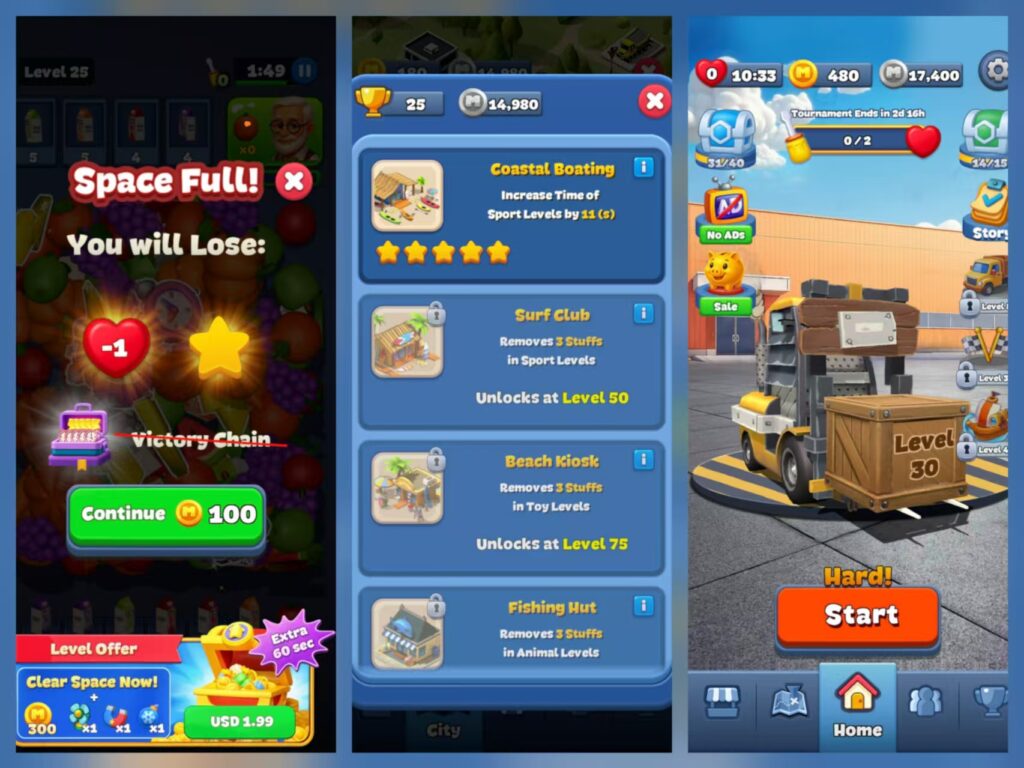
This is the game’s core drive. From the “Epic!” rating and star evaluation per level to the rewarding pop-ups for Victory and Star Chests, the feedback is immediate and satisfying. Crucially, the game offers parallel progression paths: level advancement and building upgrades. Constructing buildings like the “Surf Club” or “Coastal Building” for permanent buffs (e.g., increased time) lets players feel constant progression, even when stuck on a tricky level.
3. Empowerment (6/10)
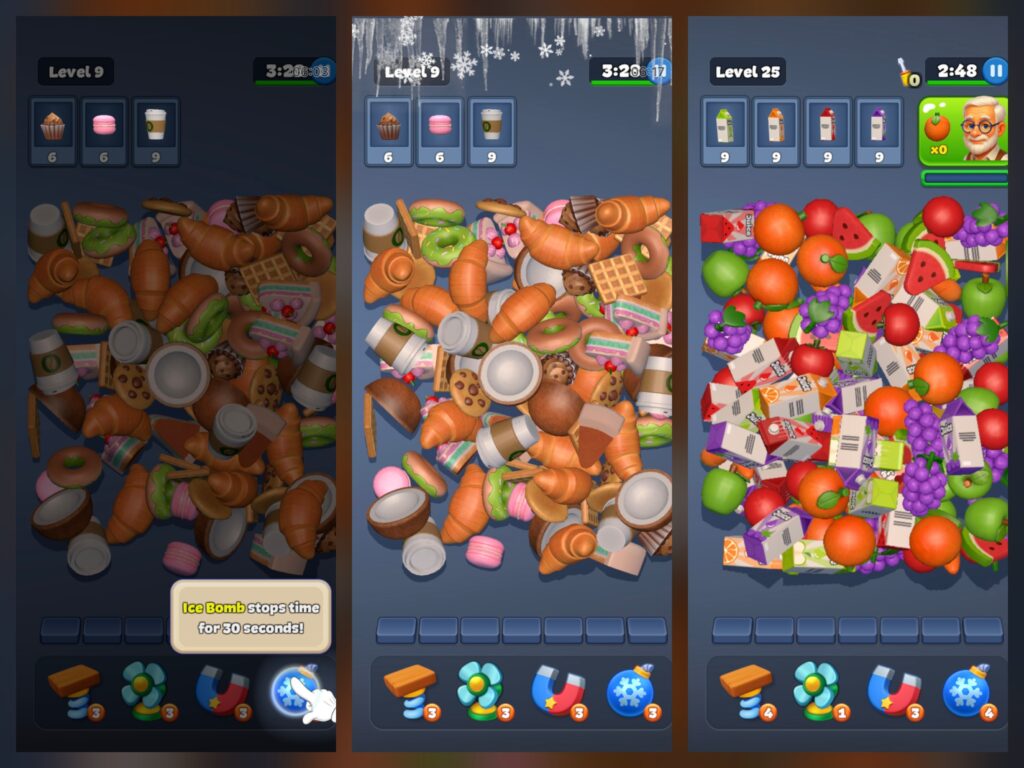
The game offers some strategic space. Players must decide which Booster to use, like the “Victory Chain” or the time-freezing “Ice Bomb.” Facing messy stacks of 3D items, deciding which set to match first and how to trigger combos requires planning and foresight. However, this creativity is somewhat constrained by fixed level objectives.
4. Ownership (8/10)
Ownership manifests on multiple levels: accumulated coins and gems, owned Boosters, and the various buildings unlocked and upgraded through investment (e.g., “Coastal Building,” “Surf Club”). These virtual assets, especially buildings requiring high levels (e.g., Lv. 50, Lv. 75) to unlock, become trophies – proof of the player’s invested time and effort.
5. Social Influence (5/10)
The game includes a “Friends” system and a “Top Players” leaderboard, allowing you to add friends and check level rankings. However, current social interaction is limited – there’s no real-time collaboration or PvP, making it largely one-sided comparison. If you enjoy quietly climbing the ranks, this system suffices. Seeing a player like “Moto” reach level 5,805 does provide some social proof and competitive drive.
6. Scarcity (8/10)
The game cleverly employs multiple forms of scarcity. Level timers (e.g., 1:49) create resource scarcity; Boosters require coins or real money; certain buildings are locked behind high levels (e.g., Lv. 90). Furthermore, “No ADs” and “Sale” pop-ups themselves utilize limited-time offers to prompt player spending.
7. Unpredictability (5/10)
The layout of items changes each level, ensuring no two are identical. The satisfying screen-clear effect from using Boosters like the Ice Bomb also provides momentary delight. However, the core gameplay loop (match-clear) remains constant, so the novelty can diminish over the long term.
8. Avoidance (9/10)
This is the core of the game’s “monetization hook.” Upon failure, the game explicitly states “You will Lose: Victory Chain” and offers a “Continue” option, usually costing coins or watching an ad. This directly taps into the player’s desire to avoid losing hard-earned progress and items. Even the naming of the “Hard!” mode sets a psychological challenge; failure often triggers determination rather than frustration, pushing players to try again or use items to avert loss, leveraging the sunk cost mentality.
Conclusion
While not revolutionary, Match 3D Triple: Factory Mania carves its niche in the 3D tile-matching genre. It masters the “easy to learn, hard to master” principle, complemented by a clear progression system and light narrative, making it compelling enough to burn through several levels during commutes or while waiting.
[Read More] https://us.09gamereview.com/blog/
[YouTube] https://www.youtube.com/@09GameReview
[Google Play Store] https://play.google.com/store/apps/details?id=com.ActionGames.Match3D
Leave a Reply