

Pixel Flow is a new match-3 style game recently ranking in the top five on the US popularity charts. Its rules are simple, but its strategic depth is genuinely innovative. The game interface is divided into three main areas: the shooter at the bottom, a moving conveyor belt, and the target color blocks at the top.
Your goal is to select colored balls from the bottom and shoot them onto the conveyor belt. When three or more balls of the same color connect, they automatically clear. The main objective is straightforward: eliminate all the target blocks on the screen.
What truly fills the game with strategy is its physics-based collision system. The balls you shoot will roll and collide on the conveyor, altering the positions of other balls. These chain reactions turn simple shooting into puzzles requiring prediction and calculation. A precise shot can trigger a satisfying combo clear, giving players an instant boost of satisfaction.
As you progress through the levels, you’ll encounter various challenges:
- Increasing color varieties complicate decision-making.
- Changing conveyor speeds test your reaction skills.
- Special obstacles appear, requiring clever navigation.
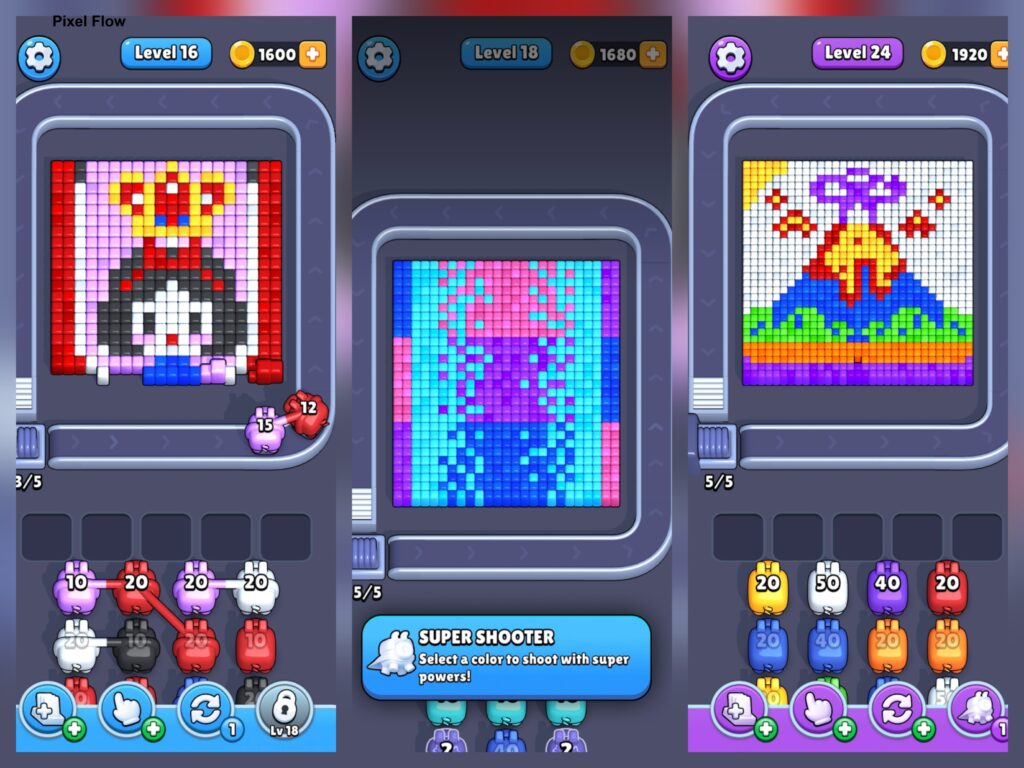
Next, let’s use the Octalysis Framework to delve into how Pixel Flow captivates players through its innovative design in form and mechanics.
Octalysis Scorecard
| Core Drive | Score (1-10) | Analysis Summary |
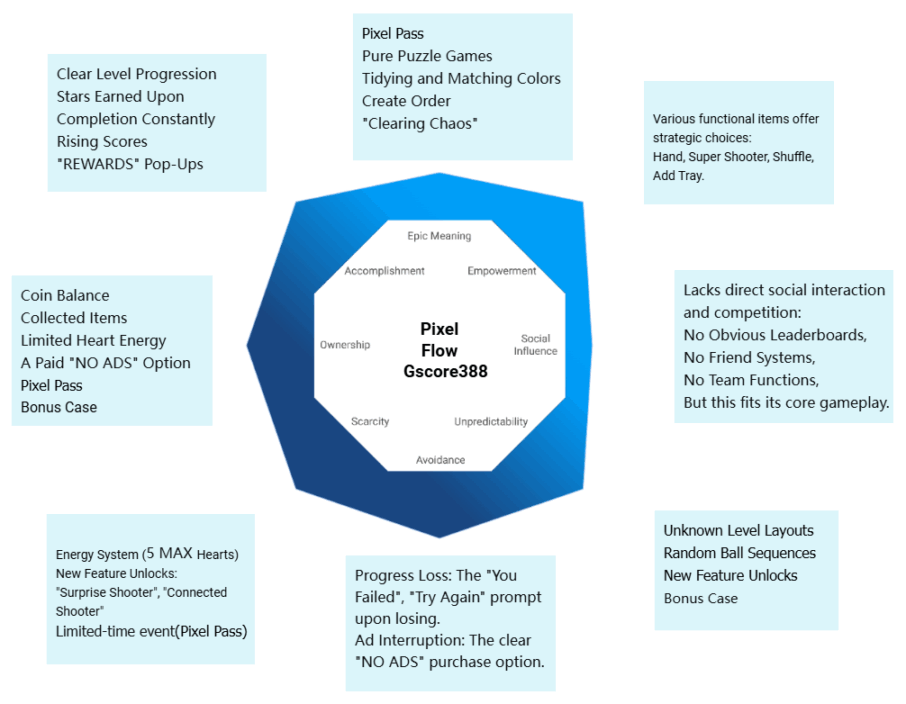
| Epic Meaning | 5 | No grand narrative; provides intrinsic goals of level conquest and feature exploration. Such as the Pixel Pass introducing a limited-time objective — a “seasonal mission.” |
| Accomplishment | 8 | Levels, stars, scores, and difficulty curve form a clear growth path. |
| Empowerment | 8 | Various functional items offer rich strategic choices and a sense of control. |
| Ownership | 7 | Energy, coins, items, Bonus Case and the ‘No Ads’ privilege. |
| Social Influence | 3 | Lacks direct social interaction and competition. |
| Scarcity | 8 | Energy system, item limits and Limited-time event(Pixel Pass) enhance drive. |
| Unpredictability | 7 | Curiosity about unknown level layouts, random ball sequences, and new feature unlocks. |
| Avoidance | 7 | Failure penalties, exclusive event rewards and ad interruptions effectively utilize player aversion. |
Evaluation Notes:
Scoring range: 1–10. Higher scores reflect stronger implementation of the core drive and greater player motivation.
GScore (Gamification Score): Calculated using the Octalysis Framework tool.
Octalysis Radar Chart
From the radar chart, we can clearly see that Pixel Flow forms a solid iron triangle of core drives in Accomplishment, Empowerment, and Scarcity. Although its Social aspect is weak, for a puzzle game focused on personal experience, this arguably makes it more pure.
Detailed Analysis
1. Epic Meaning (5/10)
Like most pure puzzle games, Pixel Flow doesn’t have a grand “save the world” storyline. The player’s core “mission” is to create order by tidying and matching colors. It primarily offers the satisfaction of “clearing chaos” and a sense of responsibility to complete objectives.
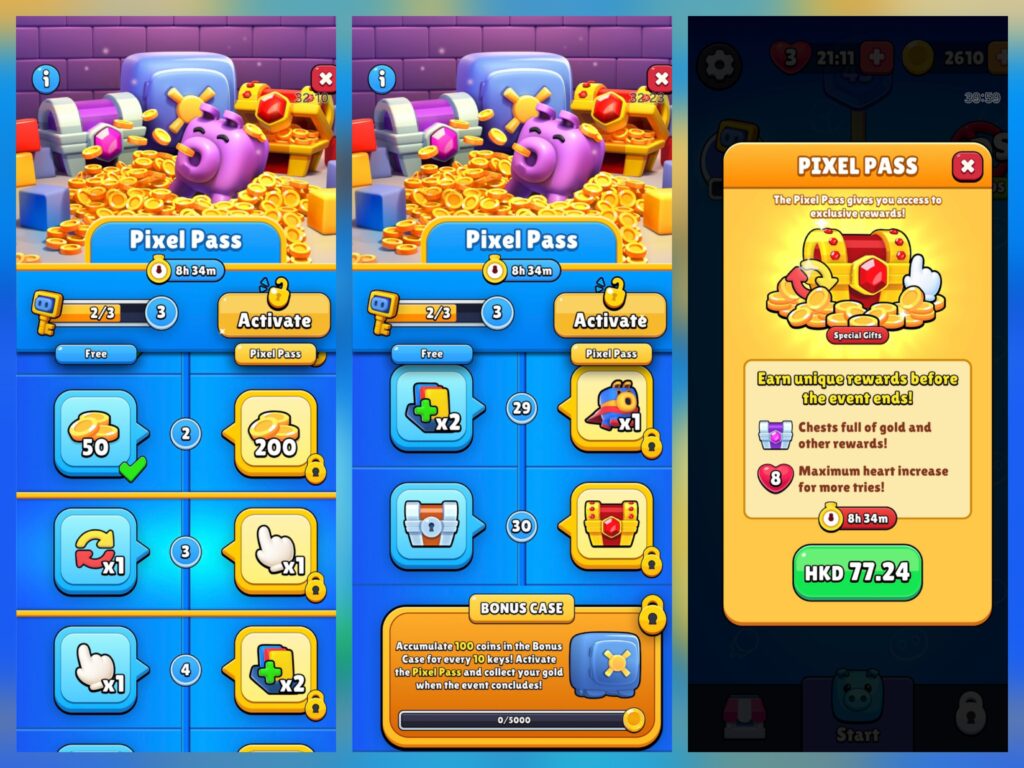
However, after reaching Level 30, a limited-time event — Pixel Pass — is unlocked, adding a sense of a timed seasonal objective to the game.
2. Accomplishment (8/10)
The achievement system is the core driver. The game features clear level progression (e.g., LEVEL 24’s “Hard” mode). Stars earned upon completion, constantly rising scores (1640→1920), and “REWARDS” pop-ups provide immediate positive feedback. The smooth difficulty curve ensures you consistently feel a sense of growth through the challenges.

The “Pixel Pass” event complements the level system by providing a parallel, visual progression ladder. You can clearly see every tier’s rewards from the “Free” track to the “Activate Pixel Pass” premium track. However, this event suddenly appears only at Level 30, with no prior indication for players in the early game.
3. Empowerment & Creativity & Feedback (7/10)
The game provides four items to help players tackle different situations, solving problems through strategy and choice:
- Hand: Freely choose a shooter from the queue, breaking sequence limits and enhancing strategy.
- Super Shooter: Manually select a color to shoot, delivering a satisfying screen-clearing effect.
- Shuffle: Reorder the queue, offering a lifeline in desperate situations.
- Add Tray: Add an extra tray, giving you more room to maneuver when stuck.
4. Ownership & Possession (6/10)
Ownership is mainly reflected in the control over game progress and resources. Your coin balance, collected items, and limited heart energy are your virtual assets. The game offers a paid “NO ADS” option; once purchased, the player permanently owns an uninterrupted gaming environment.
The Bonus Case mechanic and the exclusive rewards for paying players in the limited-time event significantly strengthen the premium players’ “sense of ownership.”
5. Social Influence & Relatedness (4/10)
Based on current experience, Pixel Flow shows no obvious leaderboards, friend systems, or team functions. While this fits its core gameplay, it loses the long-term stickiness that social competition and cooperation can bring.
6. Scarcity & Impatience (8/10)
The game primarily creates scarcity through the energy system, stimulating desire for progress and a sense of urgency:
- Energy System (Hearts): After using the “5 MAX” hearts, you must wait 15 minutes for one to refill or watch an ad to get one immediately. This design controls the game’s pace while maintaining player anticipation.
- New Feature Unlocks: Features like “Surprise Shooter” and “Connected Shooter” unlock at specific levels, making you look forward to future content.
7. Unpredictability & Curiosity (7/10)
The game engages your curiosity in several ways. The sequence of colors appearing on the conveyor belt at the start of each round is random, ensuring replayability. You never know how the next wave of balls will be arranged, and using the “Shuffle” item brings instant situational changes.
Furthermore, unlocking new features like “Surprise Shooter” and “Connected Shooter” continuously sparks your exploratory curiosity.

8. Loss & Avoidance (7/10)
This drive is quite evident in Pixel Flow:
- Progress Loss: The “You Failed” prompt upon losing and the need to “Try Again” make you reluctant to accept failure and waste the time/effort already invested.
- Ad Interruption: The clear “NO ADS” purchase option directly targets players’ strong aversion to having their gameplay interrupted by ads.
- Limited-time events: Features like the coins accumulated in the “Pixel Pass” and the time-limited unique rewards effectively drive players to remain active during the event period and substantially increase the potential for paid conversions.

Conclusion
The success of Pixel Flow lies in perfecting the core experience within an extremely simple framework. It doesn’t overwhelm you with complex systems. Instead, through precise strategic items, moderate resource pressure, and clean feedback, it offers pure intellectual fun and the satisfaction of solving puzzles in just a few minutes per session.
[Read More] https://us.09gamereview.com/blog/
[YouTube] https://www.youtube.com/@09GameReview
[Google Play Store] https://play.google.com/store/apps/details?id=com.loomgames.pixelflow
Leave a Reply