
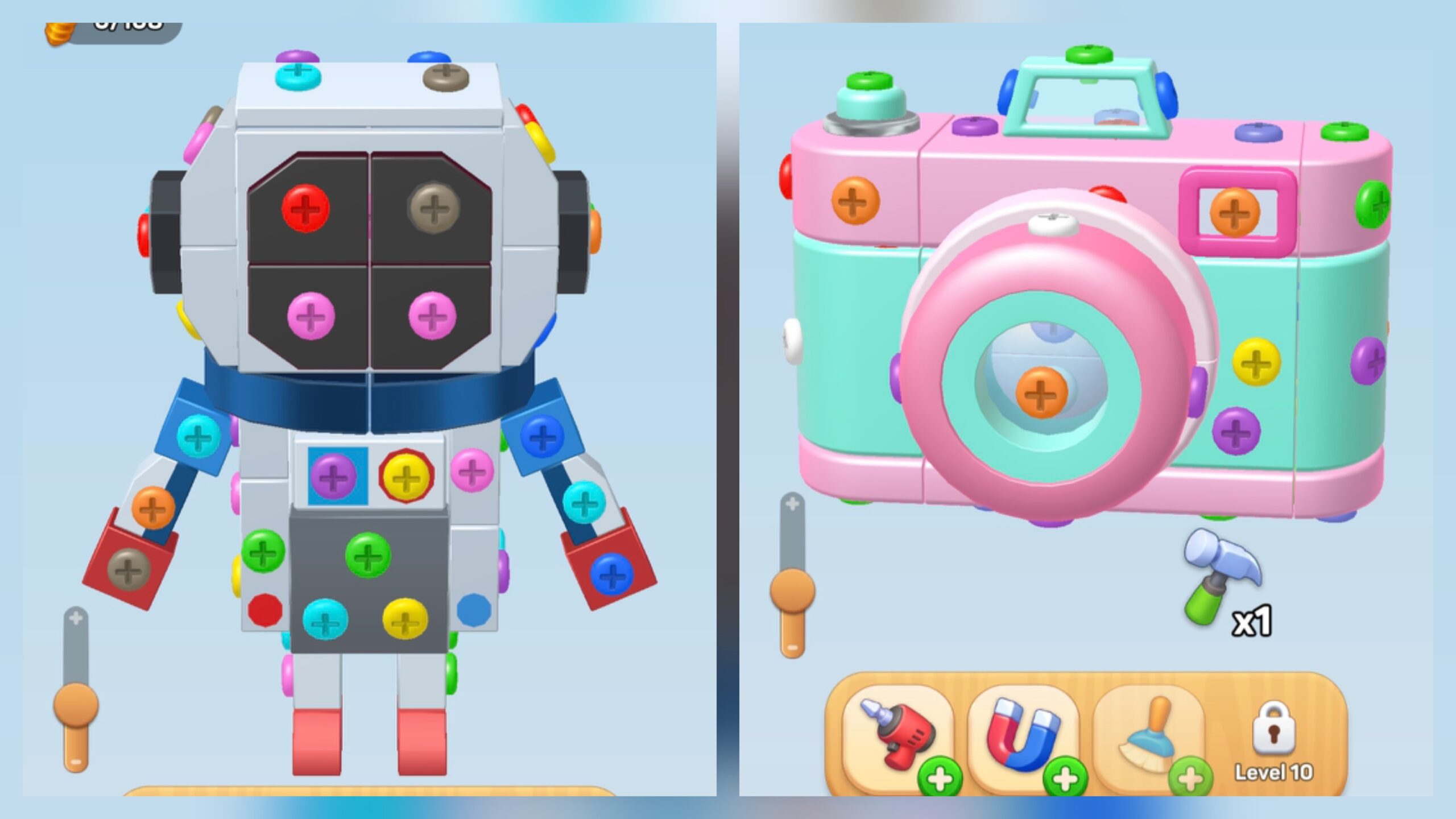
Sometimes, the simplest mechanics deliver the most direct satisfaction. Screwdom 3D is precisely that kind of game—it focuses entirely on the core physical interaction of “tightening screws,” building a micro-world around color matching and spatial puzzles. With no complex storyline or social systems, this “purity” allows us to clearly examine the core drives behind its design as a casual puzzle game.
Today, we use the Octalysis Framework to deconstruct this game. How it attempts to capture player attention using only “levels” and “tools.”
Octalysis Scorecard
Here is a quantitative evaluation of Screwdom 3D across the eight core drives.
| Core Drive | Score (1-10) | Key Game Design Manifestations |
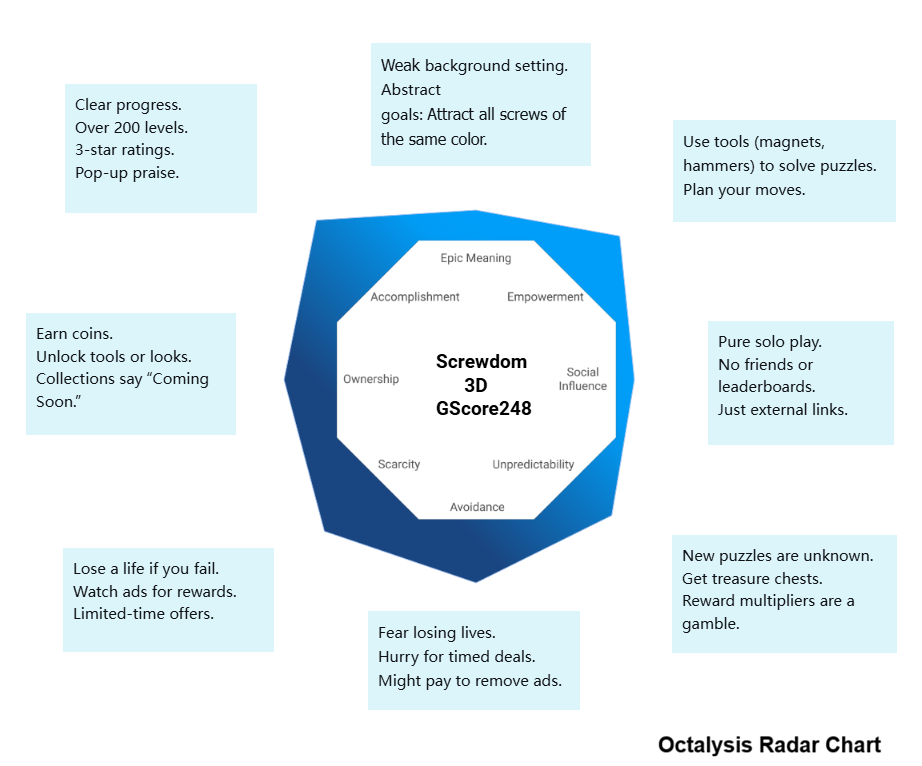
| Epic Meaning | 3 | Weak backdrop. Abstract goals (e.g., “Attract all screws of the same color”) with no narrative wrapping. |
| Accomplishment | 8 | Clear Core Progression: Linear advancement through 200+ levels, stats like “First Try Win”, 3-star ratings per level, achievement pop-ups (“Well Done!”). |
| Empowerment | 6 | Using tools like the Magnet and Hammer to solve puzzles; planning the sequence of operations for efficiency. |
| Ownership | 5 | Accumulating in-game currency, potentially unlocking new tools or skins. Collection system marked “Coming soon.” |
| Social Influence | 2 | Almost non-existent. Pure solo experience with no friends or leaderboards. Only external links for “Like/Join for reward.” |
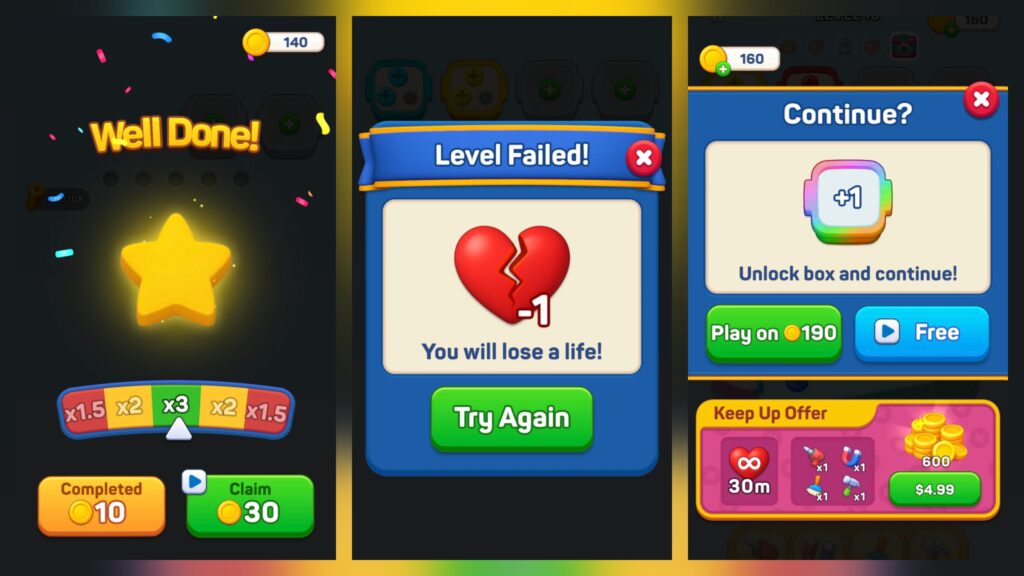
| Scarcity | 7 | Life/Energy system (losing a life on failure), watching ads for rewards, limited-time offers (“Keep Up Offer”). |
| Unpredictability | 5 | Unknown puzzle layout of new levels, reward chests after completion, uncertainty of using multipliers (x1.5, x2). |
| Avoidance | 6 | Losing lives on failure, countdown pressure from limited offers, fear of missing rewards. Likely paying to remove ads. |
Evaluation Notes:
Scoring range: 1–10. Higher scores reflect stronger implementation of the core drive and greater player motivation.
GScore (Gamification Score): Calculated using the Octalysis Framework tool.
Octalysis Radar Chart
The chart below shows Screwdom 3D‘s drive profile: a solitary peak in Development & Accomplishment, rising from a plain formed by Scarcity and Avoidance.
In-Depth Core Drive Analysis
1. Epic Meaning (3/10)
The game provides almost no backstory or emotional wrapping for its core “screw-tightening” gameplay. The player’s goal is an abstract mechanical instruction. While this allows focus on the puzzle itself, it means the game relies solely on intrinsic gameplay fun, lacking deeper narrative connection
2. Accomplishment (8/10)
This is the game’s undeniable pillar. Motivation is entirely focused on conquering one level after another. The sheer volume of 200+ levels provides a clear long-term goal; 3-star ratings per level and player stats like “First Try Win” break this down, delivering constant, high-frequency achievement feedback.
3. Empowerment (6/10)
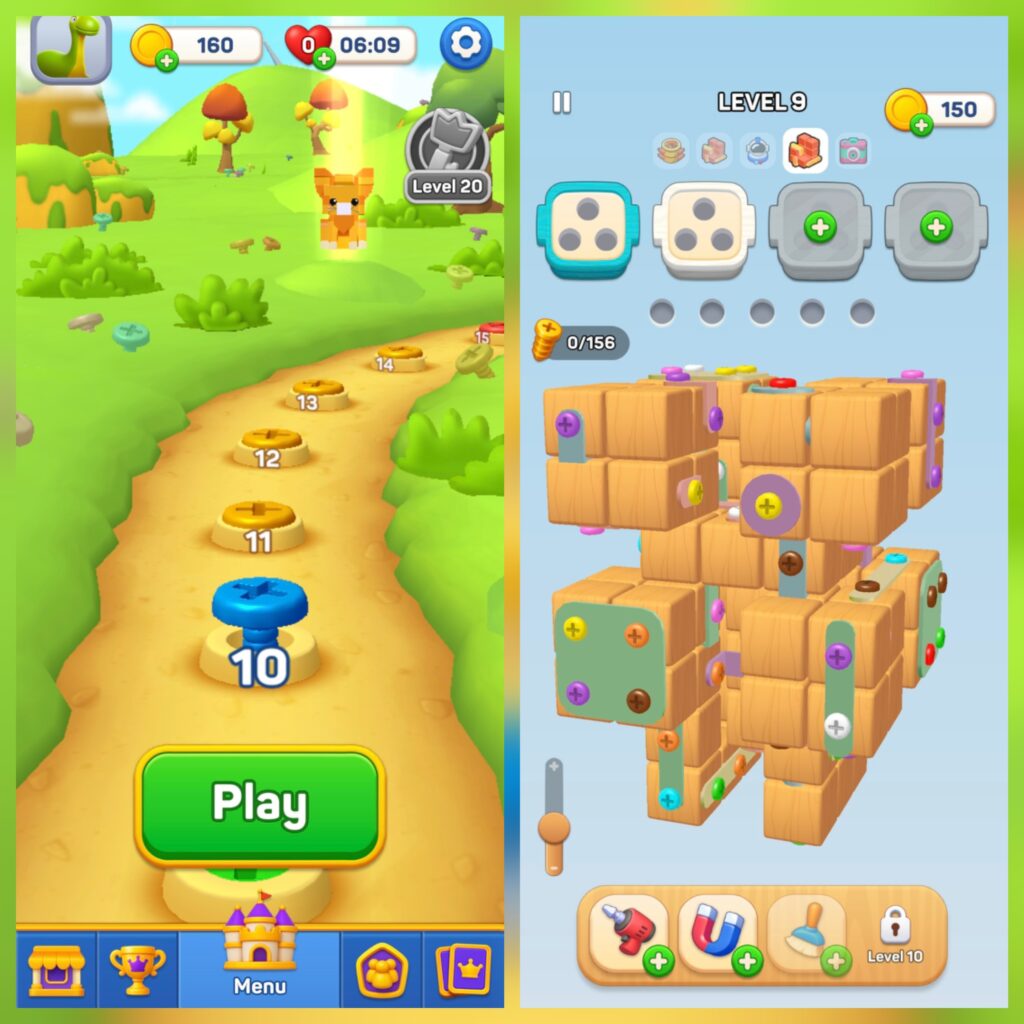
Players are not passive reactors; they actively “manipulate” levels using tools
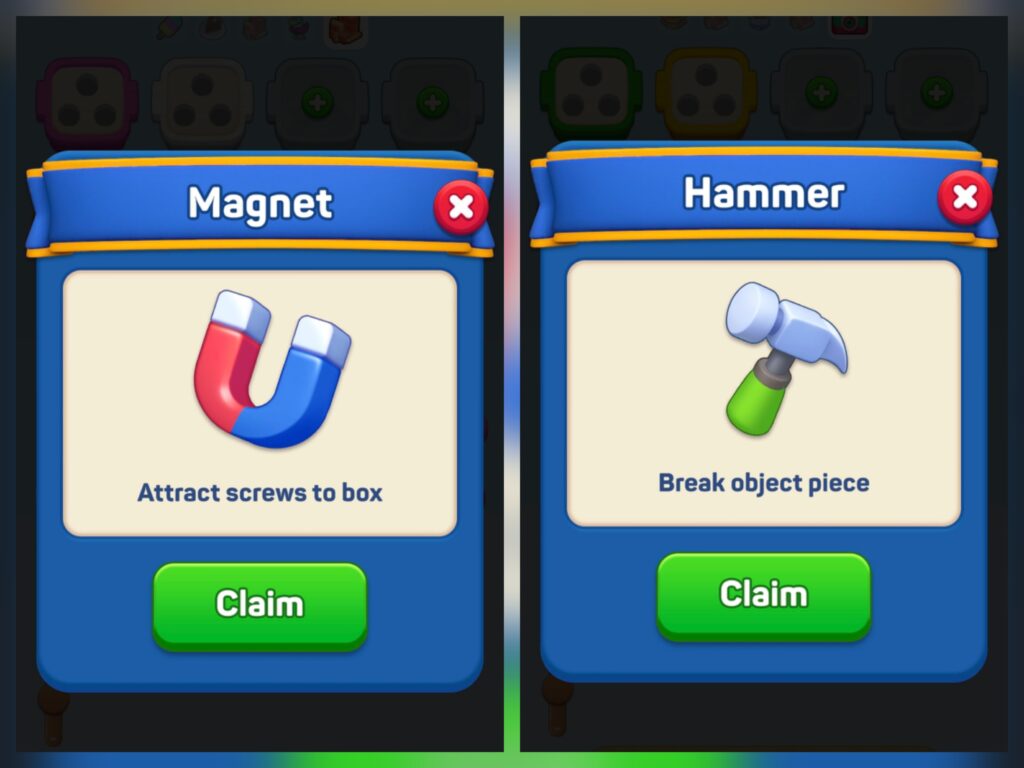
- Magnet: Attracts screws of specific colors, requiring planning of sequence and path.
- Hammer: Breaks obstacles to create new paths.
The timing and sequence of using these tools form the main strategic depth. The “aha!” moment of solving a complex level is the game’s best intrinsic reward.
4. Ownership (5/10)
Currently, ownership is tied to accumulated currency and the list of completed levels. The hinted “Collections” system is still in development. If realized, it could significantly boost collection desire and account attachment. For now, this potential is untapped.
5. Social Influence (2/10)
The game completely forgoes social dimensions. No friend comparisons, no global leaderboards. The only “social” trace is an external “Like/Join Community” link in the pause menu for minor rewards. This makes it a perfect “escape” game but means players lack community incentive when stuck.
6. Scarcity (7/10)
It uses a classic “life/energy” system to pace play. Losing consumes your lives, which then need time to replenish or watch ads. “Keep Up Offer” limited-time packs create urgency with countdowns and discounts, aiming to capture spending impulses at peak engagement.
7. Unpredictability (5/10)
Curiosity is mainly driven by the unknown layout of the next level. Reward chests after completion add slight randomness. However, due to the highly fixed core loop, this curiosity is limited and prone to fatigue.
8. Avoidance (6/10)
The game leverages several loss aversion
- Progress Loss: Failure reduces lives, potentially halting continuous play.
- Opportunity Loss: Countdown timers on offers imply “buy now or miss out.”
- Convenience Loss: Presumably, paying to remove ads avoids the potential “loss” of future interruptions.
Conclusion
In summary, Screwdom 3D is a traditionally designed puzzle game with a pure focus. Its Octalysis chart reflects its design philosophy: centered on clear “accomplishment” drive, paced by “scarcity,” offering players a structured, distraction-free puzzle corridor.
This analysis is based on the genuine gameplay experience of the 09GameReview team and the Octalysis framework. The review is neutral and provided for reference. Search for Screwdom 3D on Google Play.
Leave a Reply