
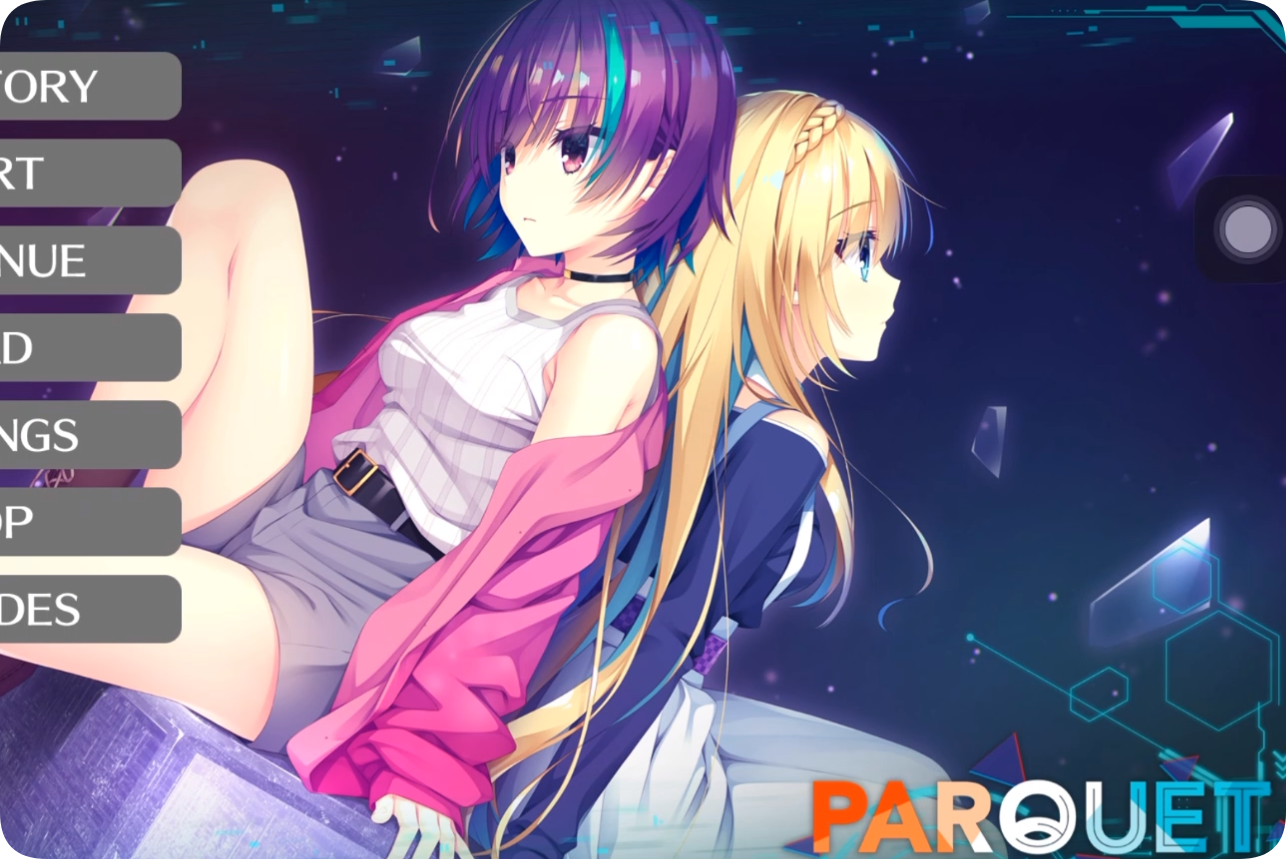
PARQUET is a Japanese-style visual novel where Brain-Machine Interface (BMI) technology allows memory data to be digitized, and through an illegal experiment a being composed of multiple memories is born. He walks into a new life alongside two girls with similarly manufactured origins, seeking identity and purpose in a world full of secrets. The presentation features high-quality art, full voice acting (for heroines), and a clean all-ages tone—delivering a story that leans more on sci-fi mystery than romance.
To see how PARQUET motivates players through narrative and design, let’s break it down with the Octalysis Framework.
Octalysis Rating Table
| Core Drive | Score (1–10) | Brief Description |
|---|---|---|
| Meaning | 8 | The protagonist’s quest for self ties the sci-fi setting, emotional stakes and narrative together. |
| Accomplishment | 6 | Finishing the story and unlocking extras gives a sense of completion, albeit less replay depth. |
| Empowerment | 5 | As a kinetic novel (with minimal choices), player agency is limited, focusing on experiencing the story. |
| Ownership | 6 | Collecting CGs, music tracks and exploring the setting builds some attachment to the world. |
| Social Influence | 4 | Community discussion and character fandom exist, but gameplay lacks competitive/social features. |
| Scarcity | 5 | Content is finite (one main route + epilogue) and unlockable extras are few—creates moderate scarcity. |
| Unpredictability | 6 | The sci-fi premise and unknown past deliver narrative surprises, though plot follows a linear path. |
| Avoidance | 4 | Few penalties or branching failures; players mainly passively consume the story. |
Evaluation Notes:
Scoring range: 1–10. Higher scores reflect stronger implementation of the core drive and greater player motivation.
GScore (Gamification Score): Calculated using the Octalysis Framework tool.
Octalysis Radar Chart
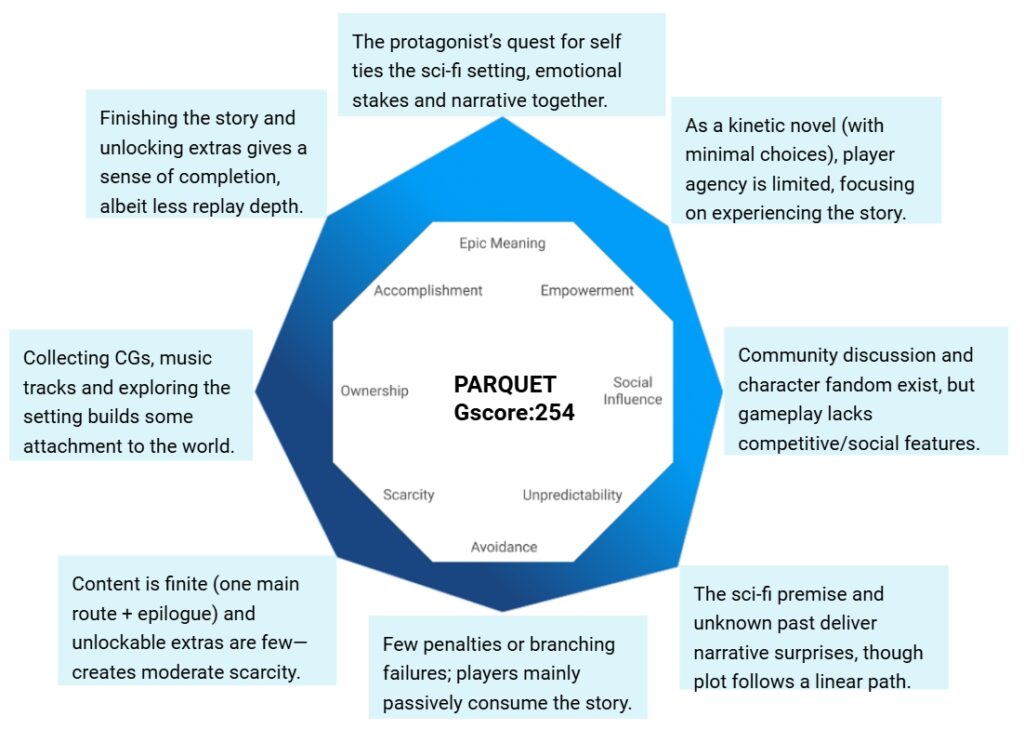
With the chart laid out, let’s now dive deeper into each core drive and how PARQUET performs.
Detailed Analysis
1. Meaning (8/10)
The game’s central narrative—of a being born from many memories seeking identity in a futuristic society—provides strong thematic weight. Players are drawn in by the character’s search for purpose and the morally ambiguous use of BMI technology. The setting supports the story and gives even day-to-day scenes a larger context of self-discovery and mystery.
2. Accomplishment (6/10)
Completing the main story plus epilogue gives players a clear milestone. The satisfaction of finishing the tale is real, but because branching routes are minimal and replay value modest, the sense of accomplishment beyond that is limited for some players.
3. Empowerment (5/10)
PARQUET provides strong presentation and narrative coaches the player through the story, but player control is minimal—there are few meaningful choices, making this more about story consumption than interactive empowerment. While the story is compelling, it doesn’t allow the player to change major outcomes.
4. Ownership (6/10)
Players accumulate extras—like art gallery unlocks, music, character profiles—and build a thematic “collection” of the experience. That provides a sense of owning part of the world. However, the finite size of the game and fewer “make it your own” features limit deeper ownership compared to larger VNs.
5. Social Influence (4/10)
Community discussion around characters, voice actors (e.g., heroines voiced by popular VA Nao Touyama) and story themes is lively. But because the gameplay element is minimal and solo-story driven, social mechanics (sharing, multiplayer, competition) are weak. The social drive is present but largely indirect.
6. Scarcity (5/10)
Content is finite but polished—there’s only one core narrative route, and extras are limited. This scarcity can increase value for players who enjoy the full experience. However, because the story is delivered in a single playthrough with no major branching, some may feel the scarcity is of the “done-once” rather than “unlock over time” kind.
7. Unpredictability (6/10)
While the structure is linear, the setting and story introduce unexpected revelations around memory, identity and technology misuse. These moments keep players engaged and pleasantly surprised. Still, once the main beats are known, the replay-shock is lower.
8. Avoidance (4/10)
Failure or “wrong paths” are not a major component—in fact, there are minimal branching failures. The experience is low-risk for the player, which means less fear of loss but also less tension. That suits players who favour story over challenge, but less so for those who crave high-stakes interactivity.
Overall Summary & Recommendation
Putting together all eight drives, PARQUET shows its strengths in meaningful narrative and polished production, while offering moderate engagement through achievement and ownership.
PARQUET delivers a heartfelt sci-fi visual novel with high production values, strong character work and an emotionally resonant core. Its weaker points lie in limited interactivity and replay depth. For players who relish story-rich visual novels and character-driven experiences, it’s a strong recommendation. For those seeking heavy branching, interactivity or high replay value, it may feel brief.
[Read More] https://us.09gamereview.com/blog/
[YouTube] https://www.youtube.com/@09GameReview
Leave a Reply