

If you’ve played the once-viral “Sheep a Sheep,” then Tile Club – Match Puzzle Game will give you that familiar addictive feeling—simple gameplay paired with social challenge. However, it successfully blends classic match-3 mechanics with light social elements.
As a casual puzzle game, Tile Club retains easy-to-learn accessibility while creating a “flow” experience that keeps players engaged through strategic depth, making it a worthy international counterpart to “Sheep a Sheep.”
Today, I’ll use the Octalysis Framework to deconstruct this game’s design and see how it makes matching tiles feel meaningful and socially connected.
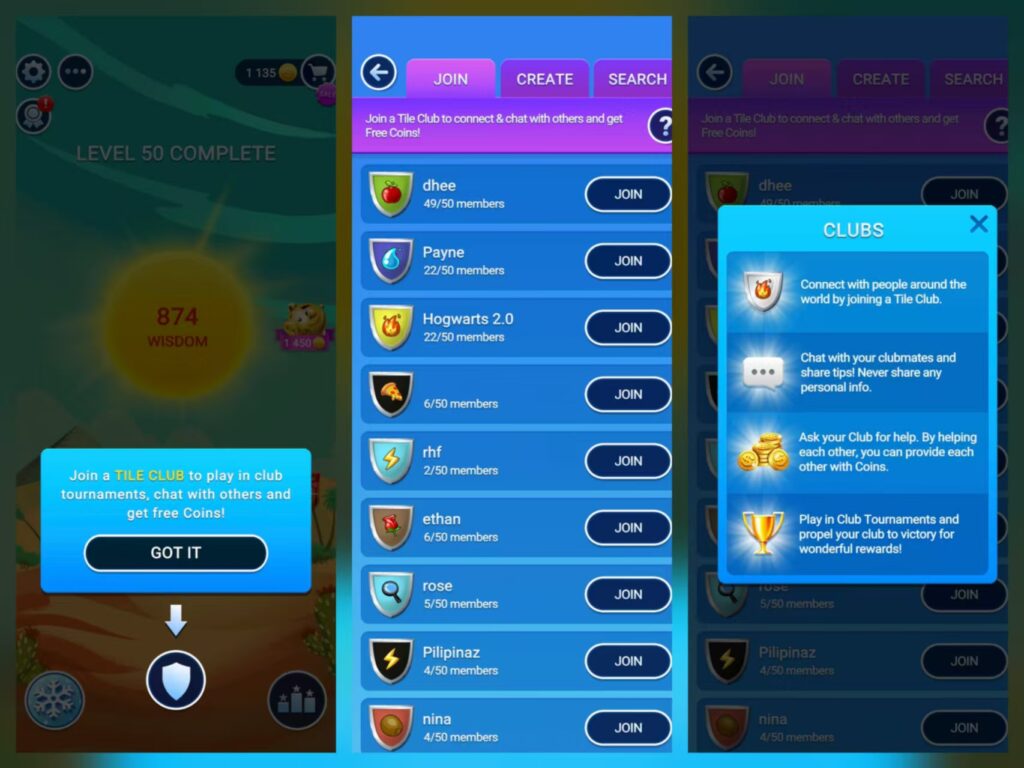
Core Gameplay: The foundation is classic match-3: clear the board by matching three identical tiles. What truly sets it apart is the Tile Club system—you can join an online community of up to 50 players to complete tasks together, participate in tournaments, and send each other free coins.
This design transforms a traditionally single-player match-3 experience into a light social activity. Just as the regional leaderboards in “Sheep a Sheep” sparked competition, the club objectives in Tile Club foster team cohesion.
The level design follows a clear progression path:
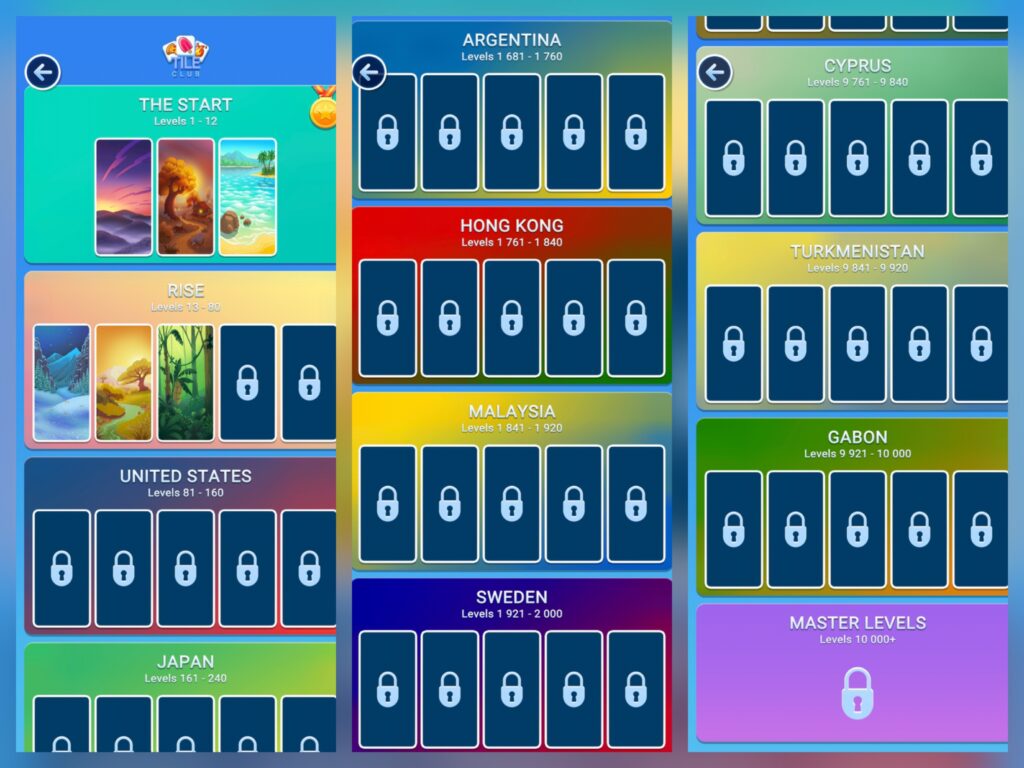
- The Start (Levels 1-12)
- Rise (Levels 13-80)
- Country/Region Themed Levels (UNITED STATES, JAPAN, etc., starting from Level 81)
Each region features unique visual styles, providing a constant sense of freshness throughout your journey.
Octalysis Rating Table
After several hours of hands-on experience with Tile Club, 09GameReview conducted a quantified assessment of its gamification design based on the eight Core Drives of the Octalysis framework.
| Core Drive | Score (1-10) | Key Design Manifestations | Motivation Type Analysis |
| Epic Meaning | 7 | Geographical theme chapters, collective club missions. | Positive drive, provides players with long-term goal orientation. |
| Accomplishment | 9 | Multi-tier progress system, quantified Wisdom score, badges, daily/weekly tasks, objective lists. | Extrinsic Motivation, delivers constant growth feedback. |
| Empowerment | 7 | Use of tools like Hint, Shuffle, Undo; strategic level design. | Intrinsic motivation + Positive drive, grants players a sense of control. |
| Ownership | 8 | Collecting “Wisdom” & Coins, personalized avatars, cosmetic items, Piggy Bank accumulation mechanism, club identity. | Extrinsic Motivation, stimulates players’ desire to collect and accumulate. |
| Social Influence | 9 | Tile Club community, help system, club tournaments, live chat, leaderboards, social sharing (Brag). | Intrinsic Motivation, creates belonging and social pressure. |
| Scarcity | 8 | Limited-time bundles, newcomer specials (Starter Pack), remove ads promotions, club member limits. | Negative drive + Extrinsic motivation, creates urgency and desire. |
| Unpredictability | 7 | Random reward levels, “meow?” easter eggs, treasure chests, rolling reward mechanism, uncertain level difficulty. | Intrinsic motivation + Negative drive, uses curiosity to drive exploration. |
| Avoidance | 6 | Prevents progress loss, paid ad removal (avoids future disruption), FOMO design, sense of club responsibility. | Negative drive, leverages players’ aversion to loss. |
Evaluation Notes:
Scoring range: 1–10. Higher scores reflect stronger implementation of the core drive and greater player motivation.
GScore (Gamification Score): Calculated using the Octalysis Framework tool.
Octalysis Radar Chart
According to the Octalysis behavior analysis Radar Chart, the gamification design of Tile Club – Match Puzzle Game exhibits a distinct profile characterized by “dual peaks leading the way, with comprehensive driving forces.”
Accomplishment and Social Influence form the two most prominent pillars in the Radar Chart, serving as the game’s core driving forces.
Surrounding these two primary peaks, Ownership and Scarcity also perform strongly, creating an effective supportive cycle. The remaining core drives are well-balanced in their scores, aligning with the game’s positioning as a casual title.
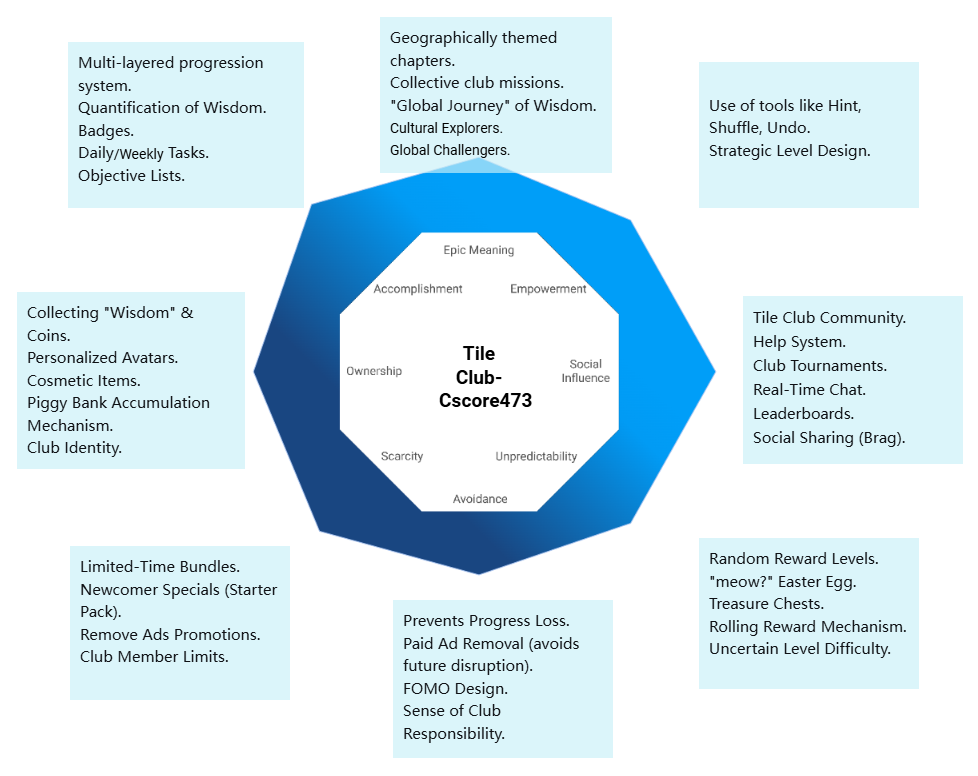
Detailed Analysis
1. Epic Meaning (7/10)
Tile Club transforms simple tile-matching into a “Global Journey” of Wisdom.
The game builds a compelling and grand “meaning” framework around the basic match-3 mechanic. It cleverly packages progression as a global puzzle-solving adventure to accumulate “Wisdom”:
- From Novice to Rising Star: The journey begins with “THE START” and “RISE,” helping players build confidence.
- Global Thematic Progression: Similar to the “Collection” systems in games like Jigsolitaire and Jilmerge, Tile Club uses geographically themed chapters. You’re not just clearing levels; you’re exploring different “regional themes.” Traveling from “THE START” to “UNITED STATES,” “JAPAN,” and later unlocking “ARGENTINA,” “HONG KONG,” and “SWEDEN” provides new level sets, visual styles, and a sense of cultural discovery. This goes far beyond a simple progress bar, granting players an identity as “cultural explorers” and “global challengers.” However, the overarching narrative remains light, primarily driven by level numbers.
- Collective Club Honor: The club system amplifies this sense of purpose. You’re no longer playing just for yourself but for your club’s ranking and to help teammates. This injects a layer of meaning beyond the core gameplay. Prompts like “Join a Tile Club to connect & chat” explicitly encourage this social connection.
- The Ultimate Master Challenge: The game currently features up to Level 10000, with the entire journey pointing toward “MASTER LEVELS” (Level 10000+), offering near-infinite challenges for top-tier players.
2. Accomplishment (9/10)
A Clear and Visible Ladder of Progress.
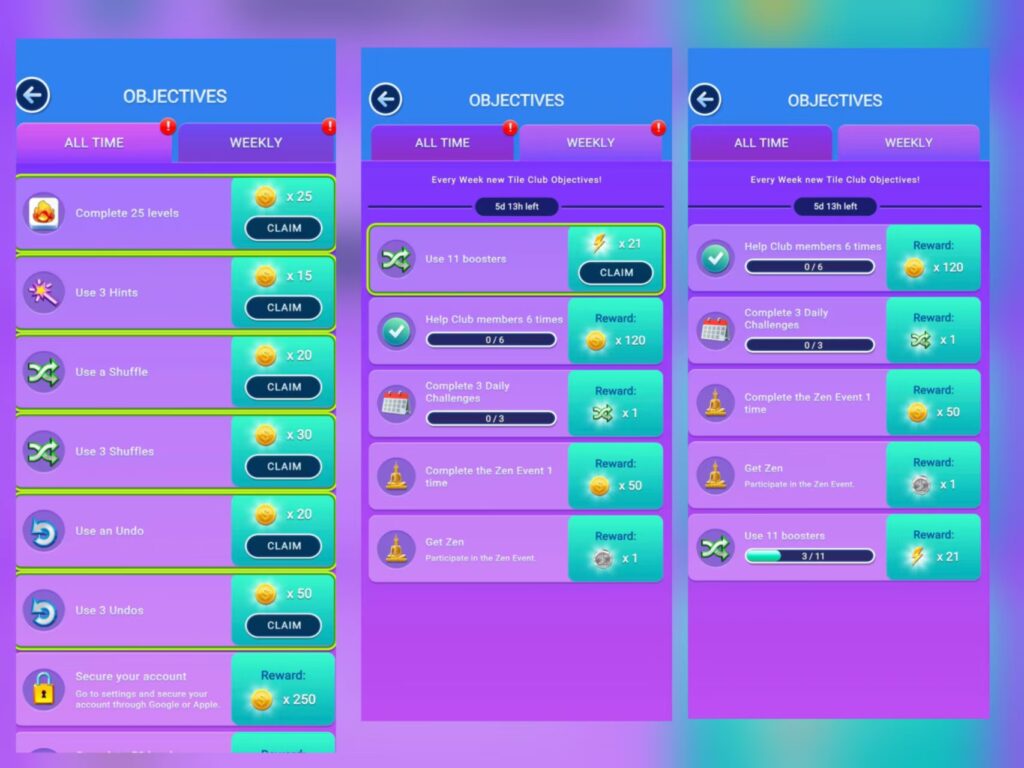
This is one of Tile Club’s strongest drives. Progressing from Level 1 to 240+ is marked by prominent progress bars and celebratory pop-ups for each completed level. The daily/weekly objective system (e.g., “Complete 25 levels,” “Use 3 Hints”) breaks down large goals into small, frequent doses of achievement feedback. This is perfectly suited for short play sessions and is a classic example of left-brain, extrinsic motivation.
3. Empowerment (7/10)
Clever Clears with Strategic Tools.
While luck plays a role, the game grants players significant control through tools like Hint, Shuffle, and Undo. Level design also incorporates strategy, requiring planning of match sequences rather than mindless tapping. Higher-difficulty levels demand thoughtful consideration of move order and tool timing. This strategic choice fosters a “flow state” and the satisfaction of problem-solving, representing positive, intrinsic motivation.
4. Ownership (8/10)
A Well-Designed In-Game Economy.
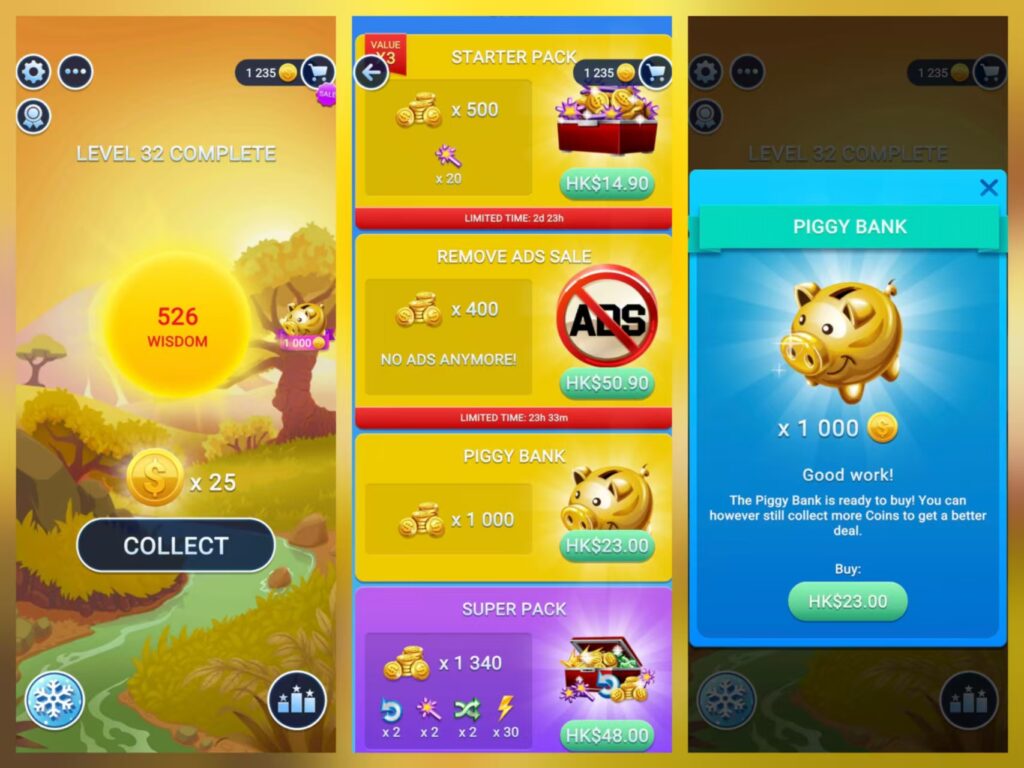
Players accumulate “Coins” and “Wisdom” through gameplay, which can be used to purchase power-ups or cosmetics. The “Piggy Bank” mechanism is particularly effective—the more you play, the more coins accumulate in the bank, reinforcing an “owner’s mindset” that buying now offers better value. This greatly incentivizes continued play and spending.
5. Social Influence (9/10)
You’re Not Playing Alone.
The “Tile Club” is the game’s core highlight. After joining or creating a club, you can:
- Request & Provide Help: Gift free coins to teammates and complete social tasks.
- Club Tournaments: Fight for common goals with club members to earn generous rewards.
- Real-time Chat: Share tips or simply socialize.
Additionally, leaderboards (global/regional) and the “Ask for Help” feature integrate social interaction naturally into the gameplay. This design transforms a solo experience into lightweight teamwork, creating a strong sense of belonging and social identity. It’s a key factor in the game’s viral potential, reminiscent of hits like Sheep a Sheep.
6. Scarcity (8/10)
The Magic of Time and Quantity Limits.
The in-game store is filled with “24-hour flash sales” (“24/29h left”), “Starter Packs,” and “Remove Ads Sales.” The 50-member cap for clubs also creates scarcity. These designs leverage the player’s “Fear Of Missing Out” (FOMO) psychology, serving as an effective short-term, negative drive.
7. Unpredictability (7/10)
What’s the Next Reward?
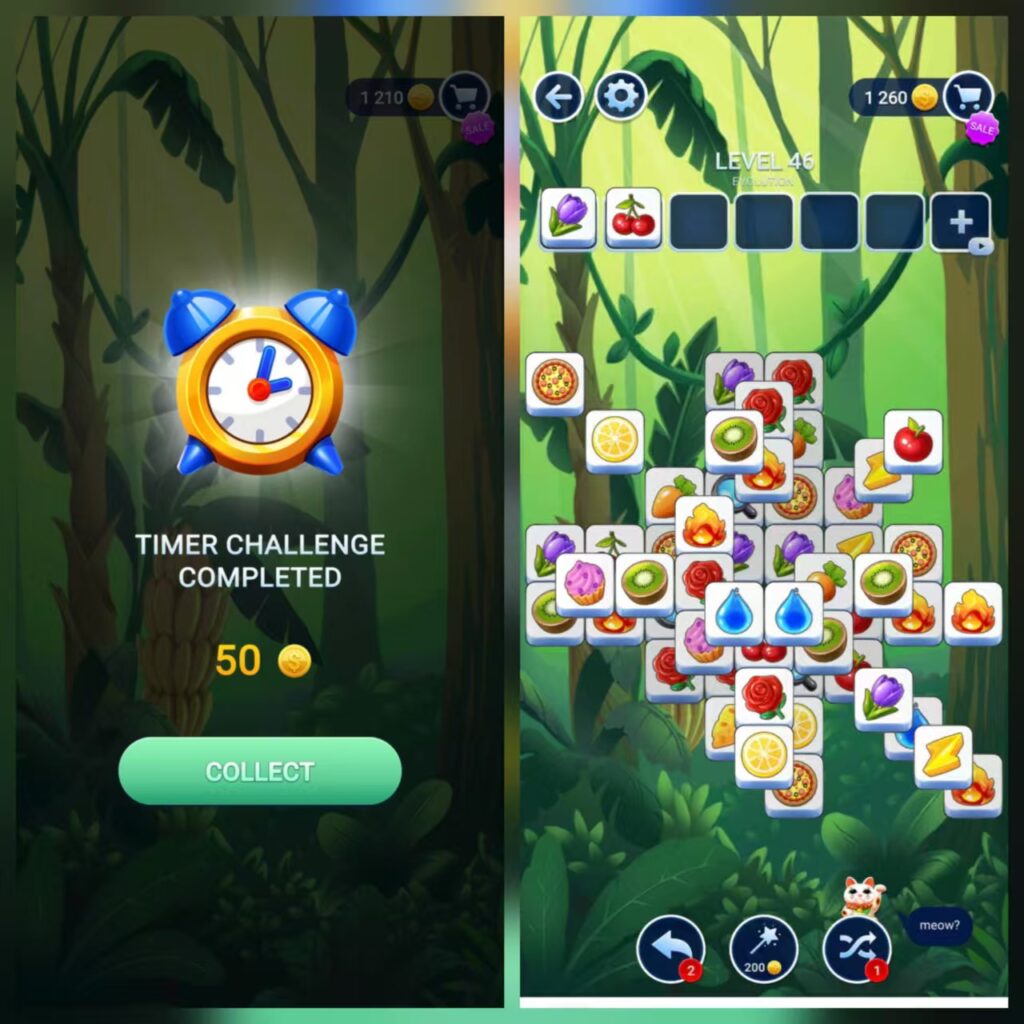
The game peppers its predictable levels with unexpected surprises. Occasional “meow?” easter eggs, randomly dropped treasure chests, the rolling chest animation after completing challenges, and minor variations in each level’s initial layout all continuously stimulate player curiosity, driving the “just one more level” exploration loop.
8. Avoidance (6/10)
Paying for “Peace.”
The game lets players experience ad interruptions first before offering a paid option to remove them. This is a classic design exploiting “loss aversion”—players pay to avoid a potential future negative experience (ad disruption). Additionally, cloud saves alleviate concerns about potential progress loss.
Conclusion
The Radar Chart clearly reveals that Tile Club is a highly mature and clearly driven social match-3 puzzle game, especially suited for players who enjoy relaxing, stress-relieving gameplay while desiring light social interaction. It has no glaring weaknesses. Instead, by strengthening the two experiences modern players value most—“personal growth” and “team belonging”—it achieves strong player retention and viral potential within the classic match-3 framework.
*This analysis is based on the genuine gameplay experience of the 09GameReview team and the Octalysis framework. The review is neutral and provided for reference. To download the game, search for Tile Club – Match Puzzle Game on the Google Play Store.*
[YouTube] https://www.youtube.com/@09GameReview
[Google Play Store] https://play.google.com/store/apps/details?id=com.gamovation.tileclub&hl=my&gl=mm
Leave a Reply