

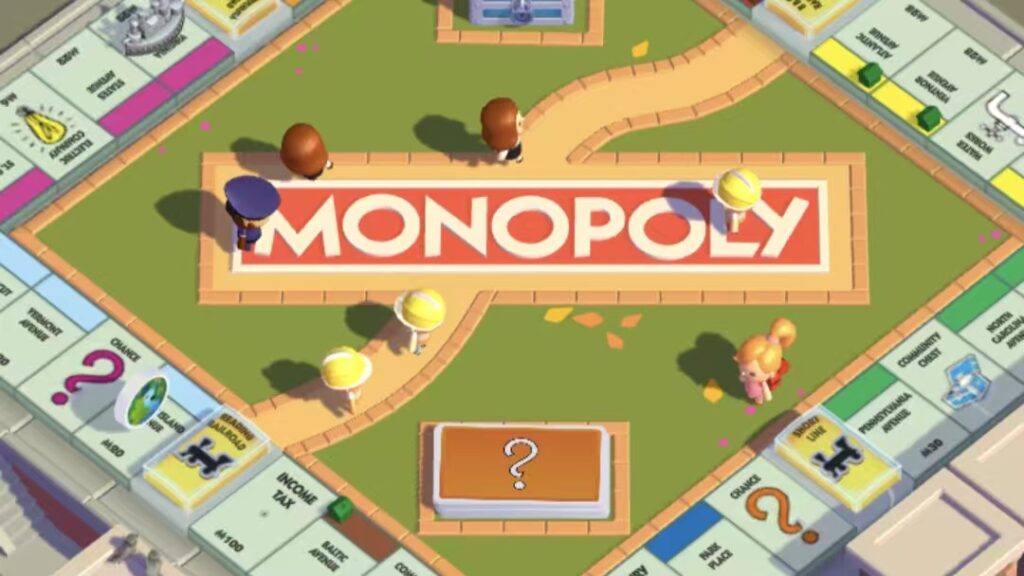
Monopoly GO! is a mobile game based on the classic Monopoly board game. It builds a multi-dimensional achievement network around “board progression, property upgrades, album collection, and daily/weekly challenges.” Simultaneously, it forms a “competition + cooperation” social loop through interactive features like the friend system, sticker trading, and raiding friends’ coins.
Today, we use the Octalysis framework to explain why this game became a breakout social mobile hit. How does it combine the power of a classic IP with mature gamification mechanics to create a gameplay loop that keeps players coming back?
Octalysis Scorecard
Here is a detailed breakdown of how Monopoly GO! leverage each of the eight core drives of player motivation.
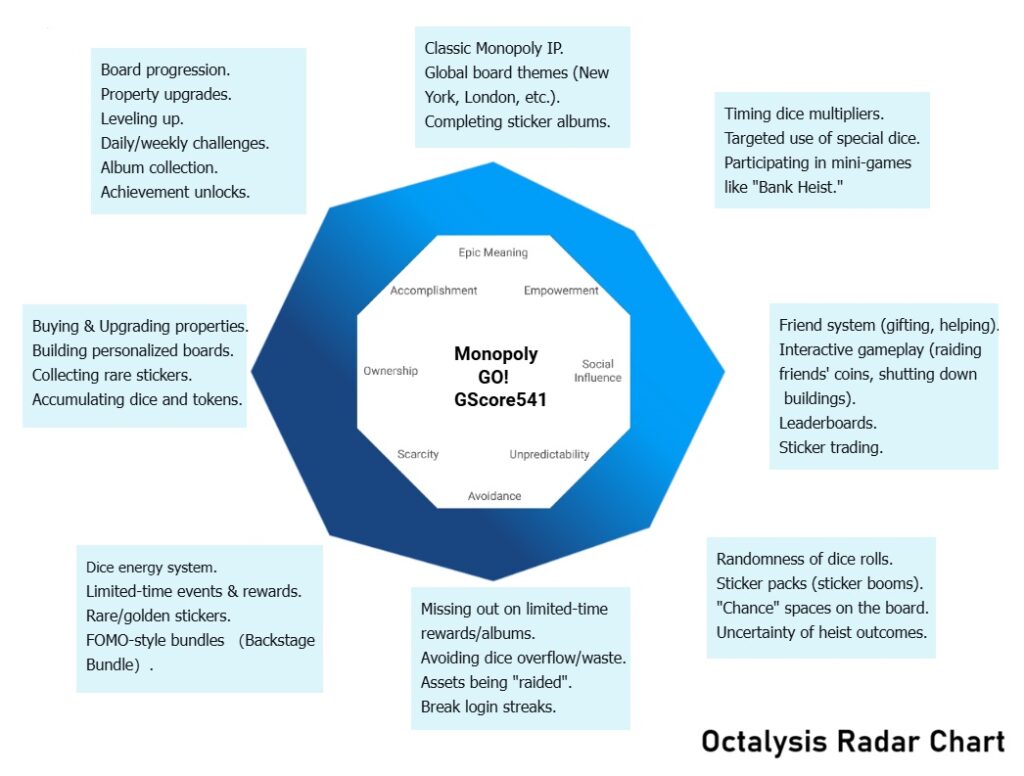
| Core Drive | Score (1-10) | Key Game Mechanisms |
| Epic Meaning | 7 | Classic Monopoly IP, global board themes (New York, London, etc.), the ultimate goal of completing sticker albums. |
| Accomplishment | 9 | Board progression, property upgrades, leveling up, daily/weekly challenges, album collection, achievement unlocks. |
| Empowerment | 6 | Limited strategic choices: timing dice multipliers, targeted use of special dice, participating in mini-games like “Bank Heist.” |
| Ownership | 10 | Core Design! Buying and upgrading properties, building personalized boards, collecting rare stickers, accumulating dice and tokens. |
| Social Influence | 9 | Friend system (gifting, helping), interactive gameplay (“raiding” friends’ coins, “shutting down” buildings), leaderboards, sticker trading. |
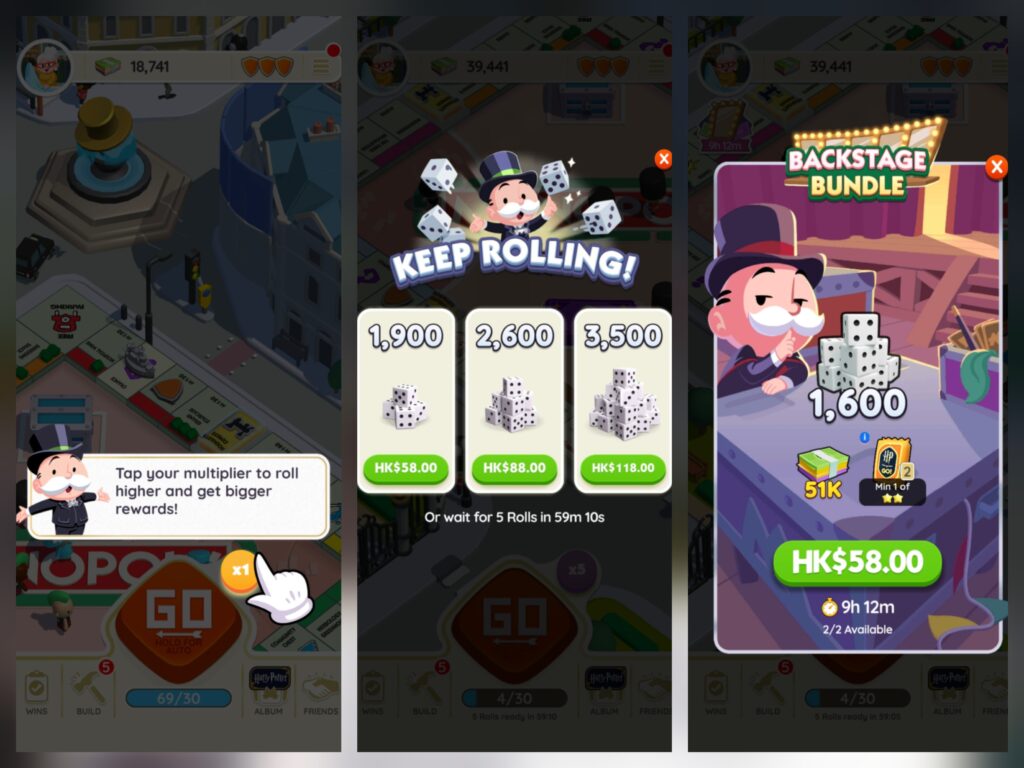
| Scarcity | 9 | Dice energy system (wait or pay), limited-time events & rewards, rare/golden stickers, FOMO-style bundles (e.g., “Backstage Bundle”). |
| Unpredictability | 8 | Randomness of dice rolls, the surprise of opening sticker packs (“sticker booms”), “Chance” spaces on the board, uncertainty of heist outcomes. |
| Loss | 7 | Fear of missing out on limited-time rewards/albums, avoiding dice overflow/waste, worry about assets being “raided” by friends, not wanting to break login streaks. |
Evaluation Notes:
Scoring range: 1–10. Higher scores reflect stronger implementation of the core drive and greater player motivation.
GScore (Gamification Score): Calculated using the Octalysis Framework tool.
Octalysis Radar Chart
Monopoly GO! Radar Chart’s Overall Profile: Modernizing a Classic IP with Strong Social Drives.
Octalysis Detailed Analysis
1. Epic Meaning (7/10)
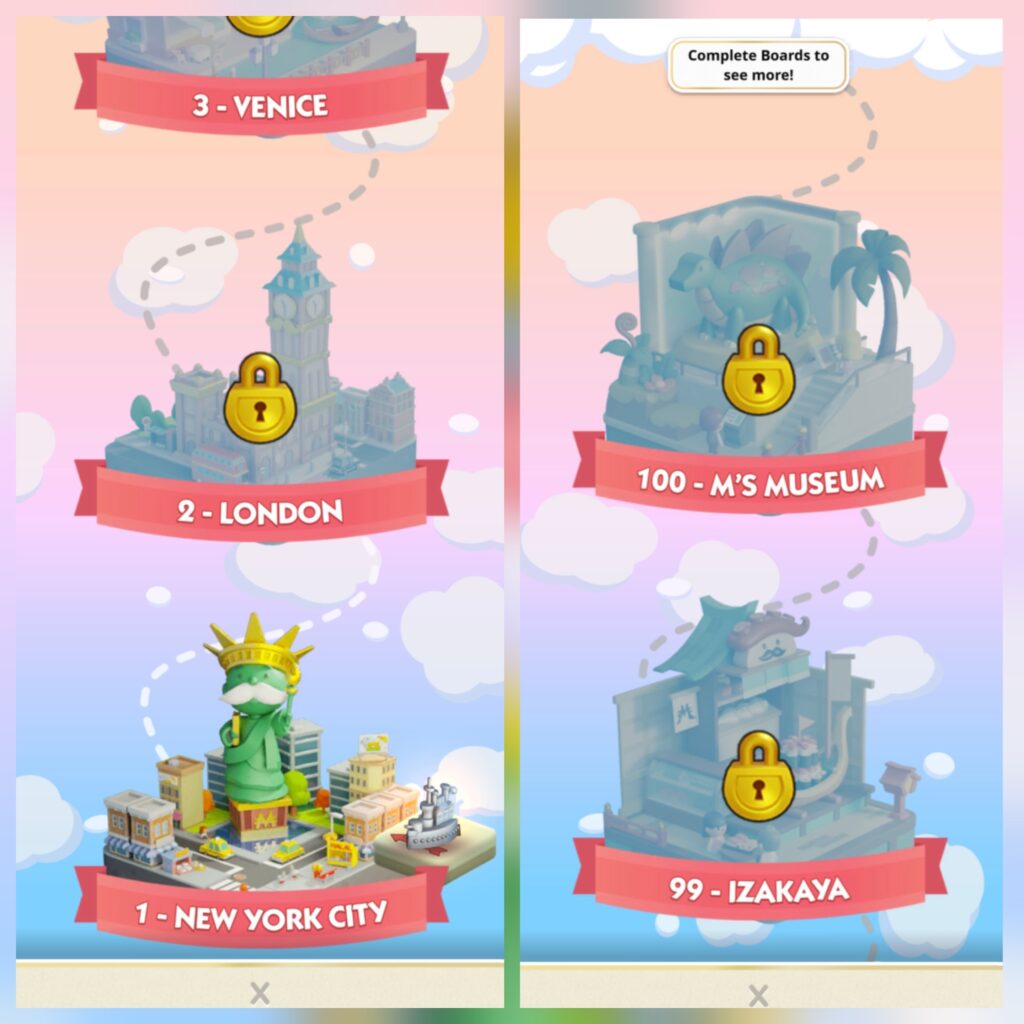
The game successfully leverages the familiar Monopoly IP to lower the barrier to entry. Players are no longer just moving tokens; they role-play as investors navigating themed boards like New York, London, and Venice. The ultimate goal—completing entire sticker albums to win “huge rewards”—provides a grand mission spanning months. This elevates collecting beyond mere gameplay, adding a touch of a cultural curator’s appeal.
2. Accomplishment (9/10)
This is the core extrinsic motivator. It provides continuous, visible growth feedback and acts as the main engine driving game progress.
- Visual Board Progression: The board advances with a clear percentage. Progress bars like “LONDON 6/30” let players know exactly how far they are from their goal. Building each property visibly increases the bar.
- Soaring Net Worth: Watching your NET WORTH skyrocket from thousands to millions delivers the most primal joy from numerical growth.
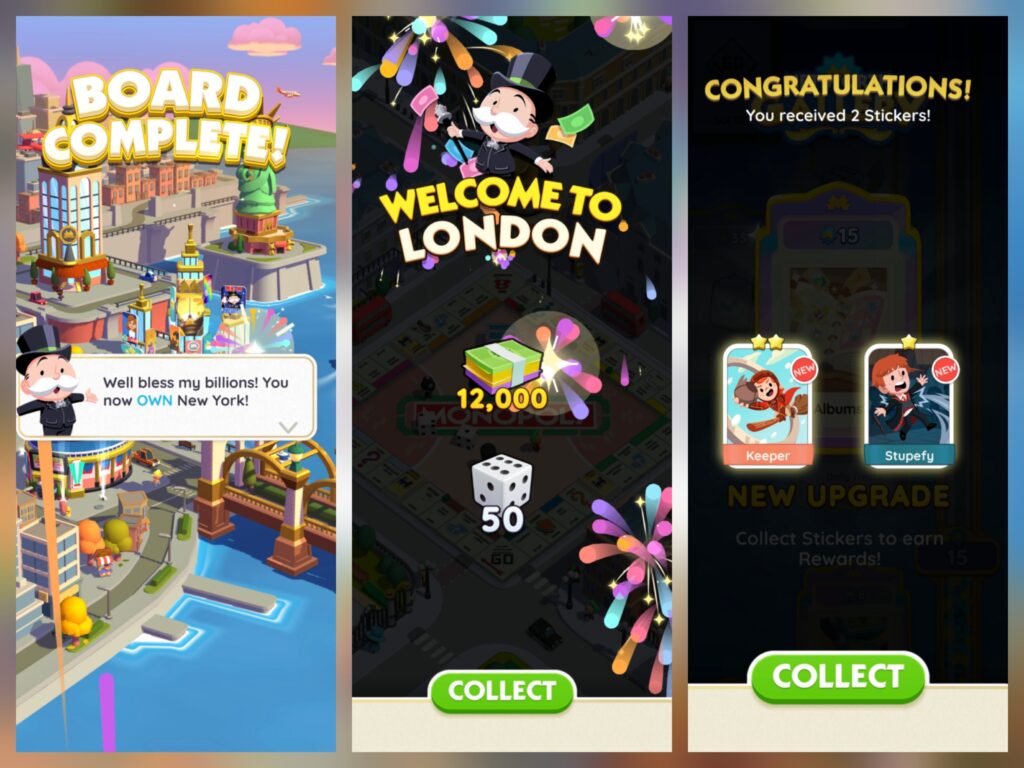
- Achievement Unlocks: Daily/Weekly “Quick Wins” and “Rent Goals” break down large objectives, offering instant gratification. Completing specific boards (e.g., Welcome to LONDON) grants massive rewards (like 12,000 dice), instantly maximizing the sense of accomplishment.
3. Empowerment (6/10)
A moderate positive drive. Compared to the classic board game, Monopoly GO!’s strategic depth has been streamlined. The core gameplay (dice rolling) is highly random, which reduces the player’s sense of control. Empowerment is granted mainly in peripheral strategy:
- Limited Resource Management: Players decide when to use “Multipliers” (x2, x3, x5) on their dice rolls to maximize their rewards.
- Raiding Strategy: In features like “BANK HEIST,” players can choose to participate in the mini-game or target specific friends. While these choices require strategic judgment, they don’t change the luck-based nature of the core loop.
- Construction Planning: Choosing which properties to prioritize for upgrades on your own board is also a form of resource allocation strategy.
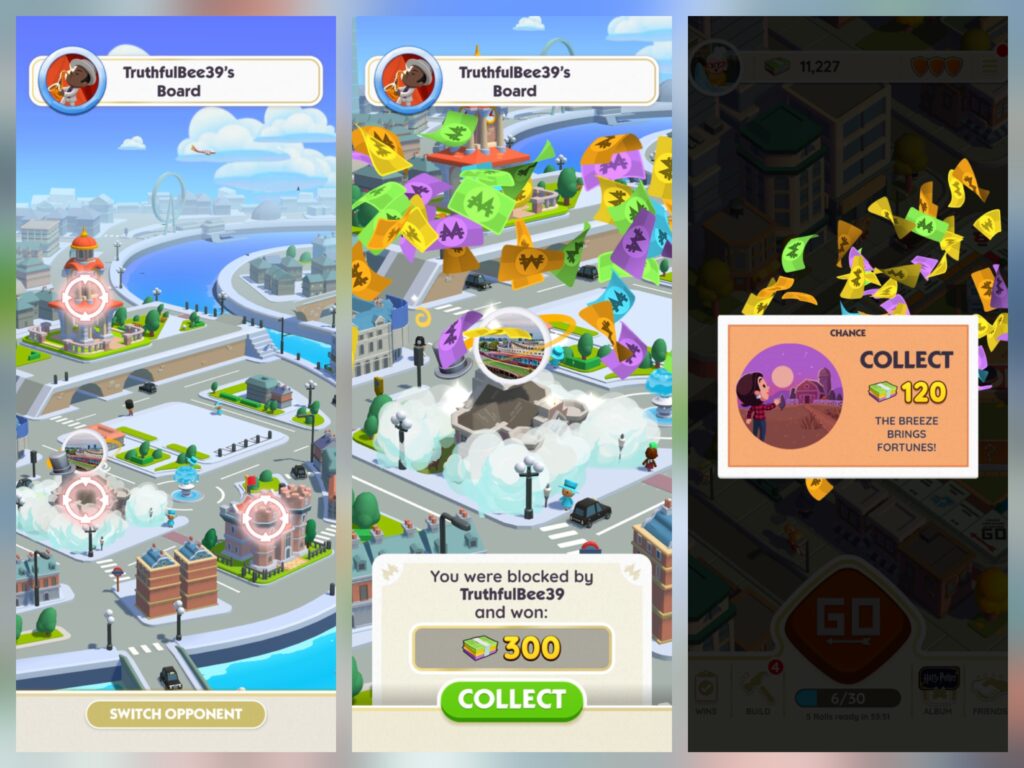
4. Ownership (10/10)
A top-tier extrinsic motivator. The game is built around “accumulation and display.” An intense sense of ownership is key to both monetization and retention.
If other match-3 games make you own power-ups, then Monopoly GO! makes you own a world. Every landmark you build, every property you upgrade, every rare sticker you collect is a tangible representation of your digital assets. The sticker trading system (trading duplicates for scarce ones) takes the “asset management” experience to the extreme, intensely stimulating players’ desire to collect and show off.
5. Social Influence (9/10)
The core intrinsic motivator. Social interaction is the soul of the game and the source of its “friendly rivalry.” It transforms a single-player experience into an interactive social network full of cooperation and light competition. Players can send free gifts to show goodwill or play harmless pranks by “raiding” their friends’ bank coins or “sabotaging” their buildings. This “frenemy” dynamic, combined with global and friend leaderboards, creates a vibrant micro-social ecosystem that greatly enhances stickiness. Themed events like “HOGWARTS EXPRESS” also foster shared community goals and topics.
6. Scarcity (9/10)
A core negative drive. The game masterfully uses scarce resources and time-limited temptations as the main pressure points driving daily activity and spending.
- Energy Limitation: Dice Rolls are the lifeline but are strictly limited. Running out forces a wait (“wait for 5 Rolls in 59m”) or a purchase, creating intense desire.
- Limited-Time Events & Rewards: All events have clear countdowns (e.g., “Time left: 48d 9h”). Rare stickers and huge rewards act as levers to prompt spending and daily logins.
- IAP Pressure: The shop constantly pops up “KEEP ROLLING!” bundles. When contrasted with the waiting time, the impulse to pay is precisely triggered.
7. Unpredictability (8/10)
A strong intrinsic motivator. Every dice roll is a mini “gacha” or “loot box” experience: What number will it land on? Will it be “DOUBLES”? The anticipation when opening a “sticker pack” for a rare card is even greater. This expectation of unknown rewards is the core intrinsic motivation driving players to overcome fatigue and keep tapping.
8. Loss & Avoidance (7/10)
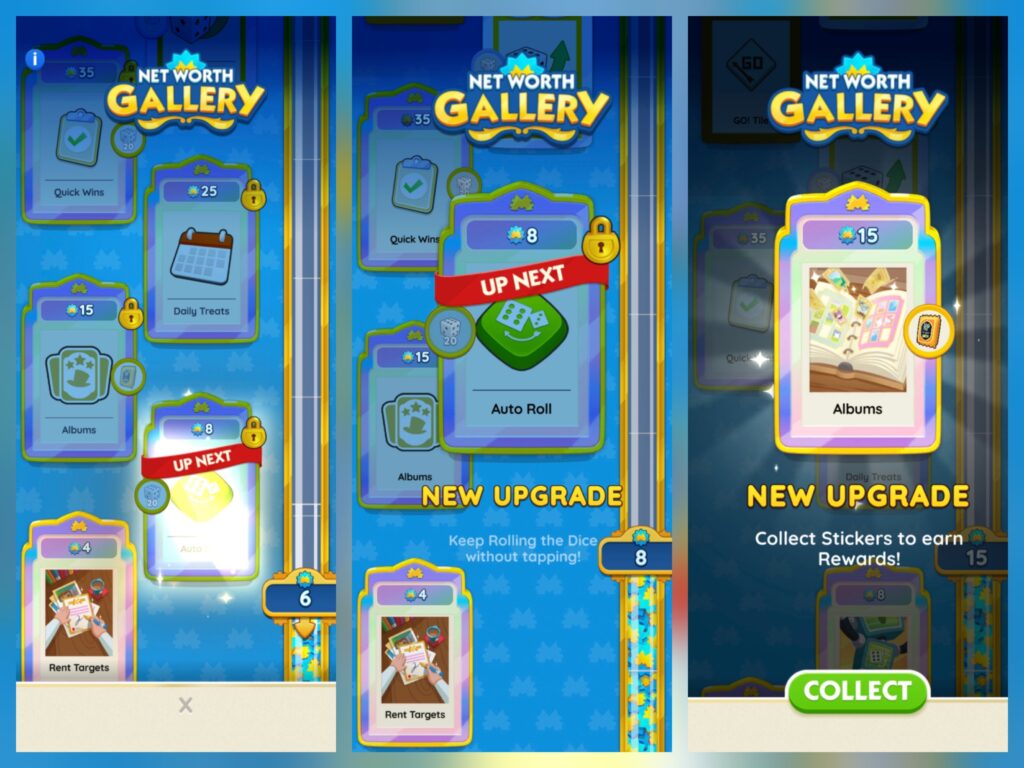
A negative drive that works subtly. Not wanting a nearly full dice stash to go to waste pushes players to use them quickly, avoiding progress loss. Fear of missing “DAILY TREATS” or the ultimate prize of a time-limited album motivates consistent logins. Worry about friends stealing large amounts of coins incentivizes upgrading the vault. The game designs these potential “loss” scenarios to push players into taking action to avoid risk. Using “Multipliers” at the wrong time or failing a heist leads to resource waste, prompting more cautious, risk-averse decisions.
Conclusion
Monopoly GO!’s radar chart reveals its success keys:
- The perfect mobile adaptation of a classic IP – Translating core elements like the board, properties, and dice into systems suited for short, frequent mobile sessions.
- The dual engines of “Collection + Competition” – Album collection satisfies the completion drive, while raiding/interaction sparks competitive drive, creating strong social stickiness.
- Masterful resource loop design – Dice, as the core resource, links all gameplay through their acquisition, consumption, and limitation mechanics, driving long-term engagement.
This design is particularly suited for casual players who enjoy light strategy, collection, and interacting with friends, which is the core reason for its sustained top-chart performance.
*This analysis is based on the genuine gameplay experience of the 09GameReview team and the Octalysis framework. The review is neutral and provided for reference. To download the game, search for Monopoly GO! on the Google Play Store.*
Leave a Reply